By Seun Ibiyemi
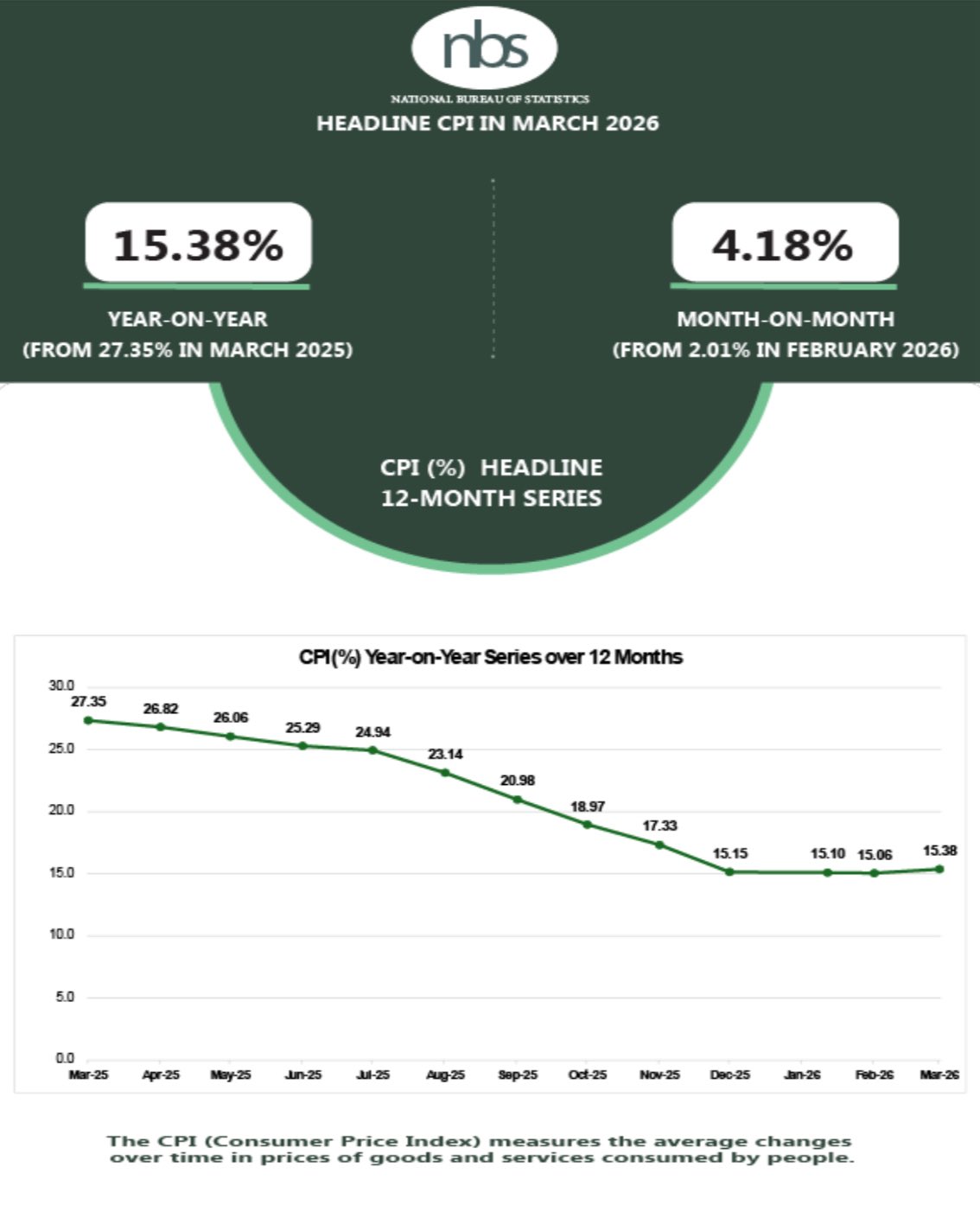
The National Bureau of Statistics (NBS) has reported that Nigeria’s headline inflation rate increased to 15.38 per cent in March 2026.
This was contained in the NBS Consumer Price Index (CPI) and Inflation Report for March 2026 released in Abuja on Wednesday.
According to the report, the figure represents a 0.32 per cent increase compared to the 15.06 per cent recorded in February 2026.
“On a year-on-year basis, the headline inflation rate for March 2026 stood at 15.38 per cent, when compared to the 15.06 per cent and 27.35 per cent recorded in February 2026 and March 2025, respectively,” the report stated.
The bureau also disclosed that on a month-on-month basis, inflation rose to 4.18 per cent in March 2026, up from 2.01 per cent in February, indicating a faster increase in average price levels.
It attributed the pressure on headline inflation largely to food and non-alcoholic beverages, restaurants and accommodation services, and transport, which contributed 5.55 per cent, 3.26 per cent and 1.80 per cent respectively.
The least contributors were recreation, sports and culture at 0.00 per cent, alcoholic beverages, tobacco and narcotics at 0.02 per cent, and insurance and financial services also at 0.02 per cent.
The report further showed that the Consumer Price Index rose to 135.4 in March 2026, up by 5.4 points from 130.0 in February.
On food inflation, the NBS stated that the rate stood at 14.31 per cent year-on-year in March 2026, lower than the 25.22 per cent recorded in March 2025.
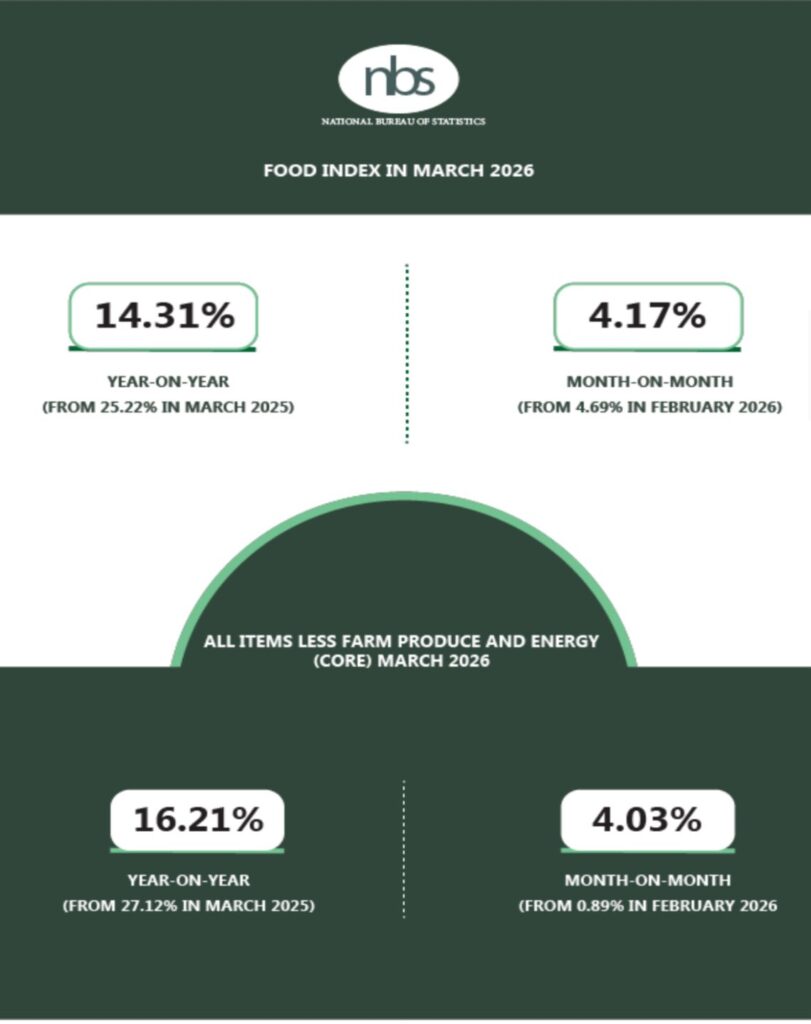
However, month-on-month food inflation rose by 4.17 per cent, though this represented a decline of 0.52 per cent compared to February.
The bureau attributed the moderation in food inflation to changes in prices of items such as yam, fresh ginger, cassava tuber, groundnuts, Irish potatoes, tomatoes, and cassava flour.
Core inflation, which excludes volatile agricultural produce and energy prices, stood at 16.21 per cent year-on-year, reflecting a decline of 10.91 percentage points from March 2025.
On a month-on-month basis, core inflation rose to 4.03 per cent from 0.89 per cent in February.
The report also showed that energy inflation stood at 6.6 per cent, farm produce at 4.6 per cent, services at 2.6 per cent, goods at 5.5 per cent, and imported food at 1.1 per cent.
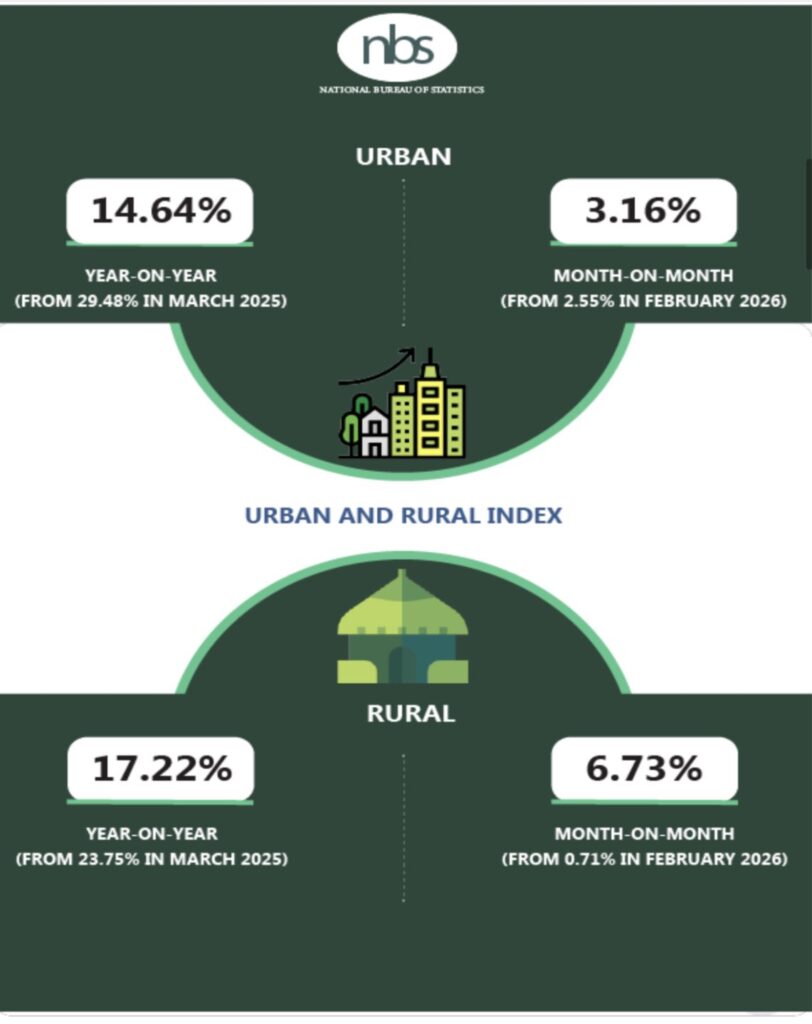
In urban areas, inflation was recorded at 14.64 per cent year-on-year and 3.16 per cent month-on-month, while rural inflation stood at 17.22 per cent year-on-year and 6.73 per cent month-on-month.
At the state level, Bayelsa recorded the highest year-on-year inflation at 27.37 per cent, followed by Sokoto (26.03 per cent) and Bauchi (23.67 per cent), while Osun (5.25 per cent), Kano (9.85 per cent) and Kaduna (10.38 per cent) recorded the lowest.
On a month-on-month basis, Zamfara (10.77 per cent), Bauchi (9.37 per cent) and Sokoto (9.05 per cent) recorded the highest increases, while Lagos (1.54 per cent), Akwa Ibom (1.80 per cent) and Rivers (1.89 per cent) saw declines.
Read Also:NGX urges Kano SMEs to leverage capital market for growth
For food inflation, Bayelsa (33.35 per cent), Sokoto (28.02 per cent) and Adamawa (21.67 per cent) recorded the highest year-on-year increases, while Kano (4.29 per cent), Oyo (4.86 per cent) and Katsina (7.48 per cent) recorded the slowest.
On a month-on-month basis, Sokoto (11.78 per cent), Niger (8.59 per cent) and Gombe (8.10 per cent) recorded the highest food inflation, while Katsina (0.09 per cent), Ogun (0.77 per cent) and Adamawa (1.30 per cent) recorded declines.