By David Oluwatosin
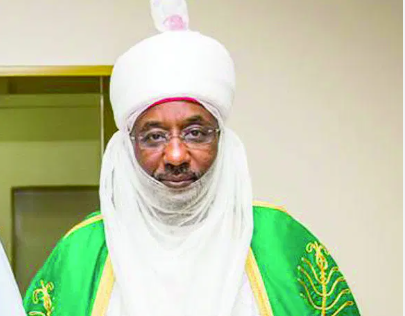
Former Central Bank of Nigeria (CBN) Governor and Emir of Kano, Muhammadu Sanusi II, has said President Bola Tinubu’s macroeconomic policies have rescued Nigeria from the brink of economic collapse, citing improvements in economic growth, inflation, foreign reserves and per capita income.
Sanusi, however, faulted the administration’s communication strategy, arguing that its inability to effectively explain its economic vision to Nigerians has weakened public understanding and support for its policies.
He spoke at the Oxford Global Think Tank conference convened by former Director-General of the Securities and Exchange Commission, Arunma Oteh.
The former CBN governor said the presidency had repeatedly alienated potential allies by interpreting constructive criticism and policy recommendations as coordinated attacks on the administration.
He attributed the problem to what he described as an ineffective communications team, arguing that better engagement with critics and stakeholders would help the government communicate its achievements and policy direction more effectively.
Despite the communication challenges, Sanusi maintained that Nigeria’s economic fundamentals showed significant improvement under the Tinubu administration.
Highlighting key performance indicators, he said the country’s gross domestic product (GDP) grew by 4.48 per cent in the second quarter of 2026.
Although the growth rate remains below the historic peaks recorded during the administrations of former Presidents Umaru Musa Yar’Adua and Goodluck Jonathan, he contrasted the current performance with the average growth of 0.9 per cent recorded during the Muhammadu Buhari administration.
Sanusi also identified the decline in consumer prices as evidence of improving macroeconomic conditions, saying headline inflation had fallen from about 30 per cent to 14.6 per cent.
He added that internal forecasts projected inflation could decline further to 12.5 per cent before the end of the year.
On income levels, the monarch said Nigeria’s GDP per capita, measured in dollar terms, had increased by 47 per cent since 2023.
He projected that if the current pace of recovery continued, per capita income could return to its 2005 level by late 2027.
The external sector has also recorded improvements, with Nigeria’s foreign exchange reserves rising to $55 billion, according to Sanusi.
READ ALSO:NIMASA unveils advanced drones, armoured vehicles to strengthen maritime security
However, he cautioned that the reserves remained significantly exposed to volatile foreign portfolio investments, which could create risks if international investors withdrew their funds.
He also linked improved foreign exchange inflows to higher crude oil prices arising from geopolitical tensions around the Strait of Hormuz, noting that the favourable market conditions had helped attract and retain foreign capital.
Sanusi further highlighted improvements in domestic production and trade, pointing to the Dangote Petroleum Refinery’s contribution to Nigeria’s exports.
He said the refinery’s output accounted for approximately 20 per cent of the country’s total exports, describing the development as an indication of progress in domestic industrial capacity.
The former CBN governor stressed, however, that the economic indicators should not be interpreted as evidence that Nigeria had completely overcome its challenges.
Rather, he described the improvements as an important first step towards achieving sustainable macroeconomic stability.
Concluding his address, Sanusi said that despite his personal reservations about politicians, the Tinubu administration deserved recognition for its role in moving Nigeria away from the threat of economic collapse.