
By Seun Ibiyemi
Nigeria’s state-owned energy giant, the Nigerian National Petroleum Company Limited (NNPCL), has recorded its highest crude oil production in five years, reaching 1.171 million barrels per day (mbpd) under the leadership of its Group Chief Executive Officer, Engr. Bashir Bayo Ojulari.
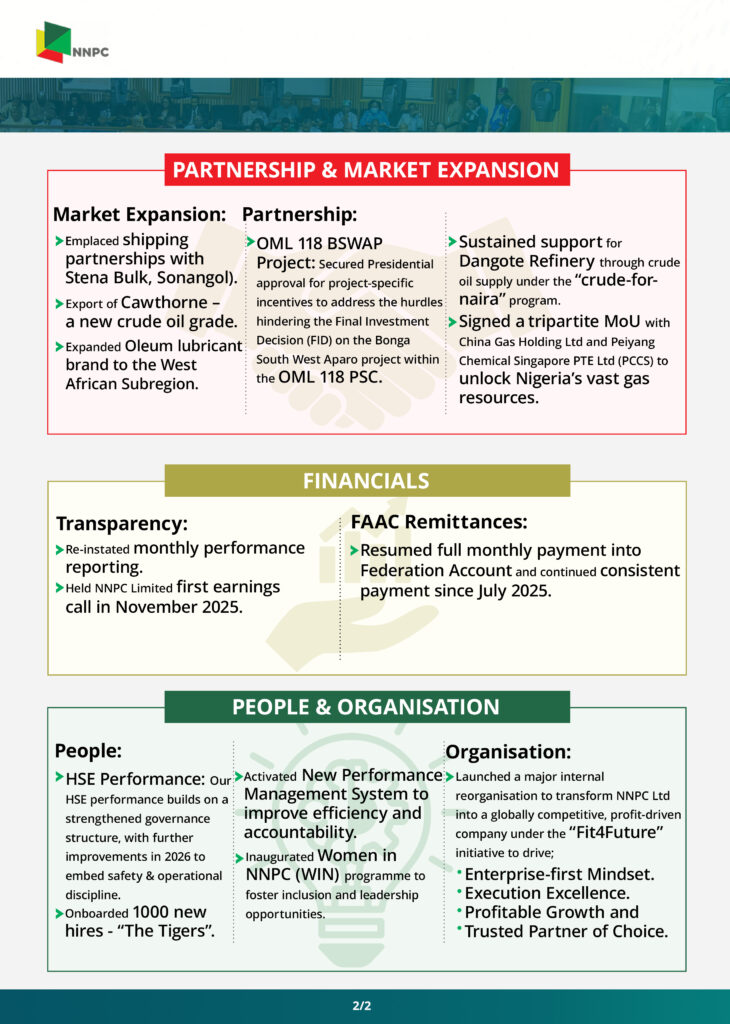
The milestone formed part of the company’s one-year performance report titled “NNPCL April 2025 – April 2026: One Year Mandate Report Summary,” released on Monday, highlighting major gains across upstream, gas, refining, and strategic partnerships.
According to the report, NNPC Exploration and Production Limited (NEPL), the upstream subsidiary of the company, also posted an all-time peak production of 365,000 barrels per day in December 2025, marking one of the strongest operational performances in recent years.
The report underscored a series of strategic moves aimed at strengthening Nigeria’s energy security and positioning the country for long-term industrial growth.
One of the major highlights was the successful execution of the Petroleum Prospecting Licenses (PPL) 2000 and 2001 Production Sharing Contract (PSC) model, described as the first PSC to include comprehensive terms for the development of deepwater non-associated gas resources.
NNPCL also disclosed that it supported the former OPL 245 Zabazaba/Ethan Project and resolved the long-standing dispute around OPL 245, leading to its conversion into new Petroleum Mining Leases (PMLs 102 and 103) and Petroleum Prospecting Licenses (PPLs 2011 and 2012).
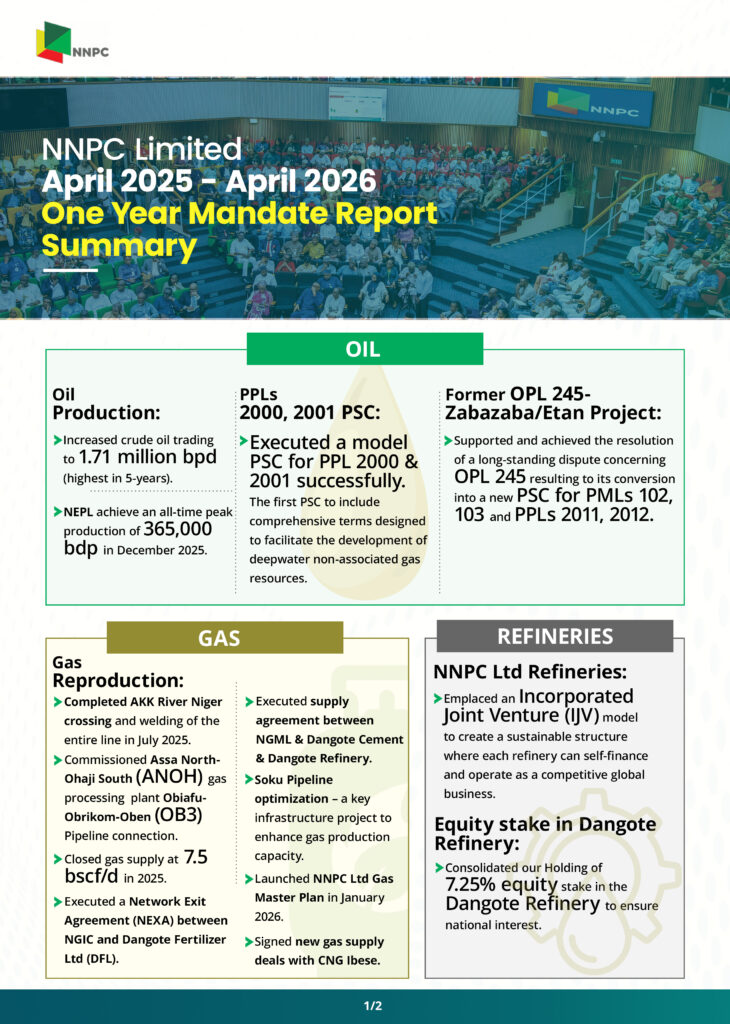
In the gas sector, the report showed significant infrastructure progress, including the completion of the Ajaokuta-Kaduna-Kano (AKK) gas pipeline River Niger crossing and welding of the entire line in July 2025.
The company also achieved the commissioning of the Assa North Ohaji South (ANOH) gas processing plant and the Obiafu-Obrikom-Oben (OB3) gas pipeline connections, helping Nigeria close gas supply at 7.5 billion standard cubic feet per day (bscf/d) in 2025.
Further strengthening domestic gas utilisation, NNPCL executed a Network Exit Agreement (NEXA) between NGIC and Dangote Fertilizer Limited, alongside a supply agreement between NNPC Gas Marketing Limited (NGML) and Dangote Refinery.
The company also optimized the Soku pipeline, a critical infrastructure project designed to boost gas production capacity.
On market expansion, NNPCL said it entered shipping partnerships with Stena Bulk and Sonangol, while also recording the export of Cawthorne crude, a new oil grade, and expanding its Oleum lubricant brand across the West African sub-region.
In refining operations, the report revealed that NNPCL introduced an Incorporated Joint Venture (IJV) model for its refineries to create a self-financing structure that would enable them to operate competitively and sustainably.
It also consolidated its 7.25 per cent equity stake in Dangote Refinery, noting that the move was necessary to protect national interest.
“Consolidated our holding of 7.25 per cent equity stake in the Dangote Refinery to ensure national interest,” the report stated.
NNPCL further disclosed that it secured Presidential approval for project-specific incentives to remove barriers delaying the Final Investment Decision (FID) on the Bonga South West Aparo project under the OML 118 PSC.
READ ALSO:Air travel crisis looms as Ground Handlers threaten shutdown over N9bn airline debt
The company added that it sustained support for Dangote Refinery through crude supply under the Federal Government’s “crude-for-naira” initiative, aimed at boosting local refining and easing pressure on foreign exchange.
In another strategic international move, NNPCL signed a tripartite Memorandum of Understanding (MoU) with China Gas Holding Ltd and Pelygang Chemical Singapore PTE Ltd (PCCS) to unlock Nigeria’s vast gas resources and deepen foreign investment opportunities.
Financially, the report stated that the company resumed full monthly remittances into the Federation Account and has maintained consistent payments since July 2025.
The one-year scorecard reflects NNPCL’s renewed push toward efficiency, production growth, gas commercialisation, and energy sector reforms under Ojulari’s leadership, as the company seeks to reposition itself as a globally competitive national oil company.