
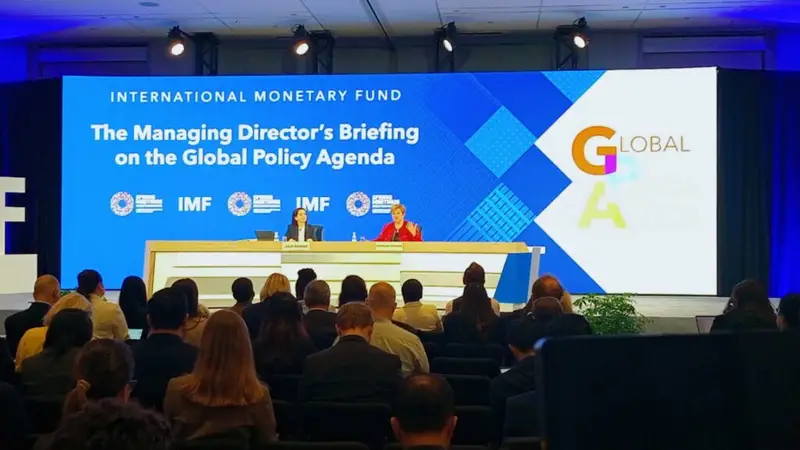
The Managing Director of the International Monetary Fund (IMF), Kristalina Georgieva, has warned that the ongoing conflict in the Middle East is posing serious risks to global economic stability.
Georgieva made this known on Wednesday during a briefing on the global policy agenda in Washington, D.C., where she expressed cautious optimism that the current ceasefire would hold and pave the way for lasting peace.
She noted that the conflict had already caused significant damage to infrastructure, disrupted supply chains, and slowed global economic growth from 3.4 per cent last year to a projected 3.1 per cent in 2026, according to the IMF’s latest outlook.
The IMF chief warned that prolonged hostilities and persistently high oil prices could further weaken the global economy, potentially driving growth down to about two per cent in a worst-case scenario.
According to her, such a downturn would have widespread consequences, as rising energy costs ripple across markets and strain economic resilience worldwide.
Georgieva explained that the impact of the crisis remains uneven, with energy-importing countries, as well as low-income and fragile economies, facing the most severe challenges due to limited financial capacity and policy options.
She urged policymakers to prioritise macroeconomic and financial stability, while carefully designing support measures for households and businesses affected by external shocks.
Georgieva also advised central banks to adopt a cautious “wait-and-see” approach where conditions allow, noting that some economies may still require early monetary tightening.
Read Also:Ododo inaugurates PAAU Governing Council, urges drive for global competitiveness
She further highlighted concerns over rising global public debt, which is projected to exceed 100 per cent of global GDP by 2029, reflecting the cumulative effects of repeated economic shocks.
The IMF boss assured that the Fund stands ready to assist member countries, with expected global financing needs estimated between 20 billion dollars and 50 billion dollars through existing and new programmes.
She added that the IMF is strengthening collaboration with international partners and refining its policy tools to help countries manage uncertainty, implement reforms, rebuild fiscal buffers, and enhance resilience against future shocks.

