
…Says rate cut signals economic recovery
… Investors lose N1.14trn as NGX reacts to MPC decision
By Seun Ibiyemi
Stakeholders in Nigeria’s financial and real sectors have expressed support for the decision of the Central Bank of Nigeria (CBN) to reduce the benchmark interest rate to 26.50 per cent, describing the move as timely and growth-oriented.
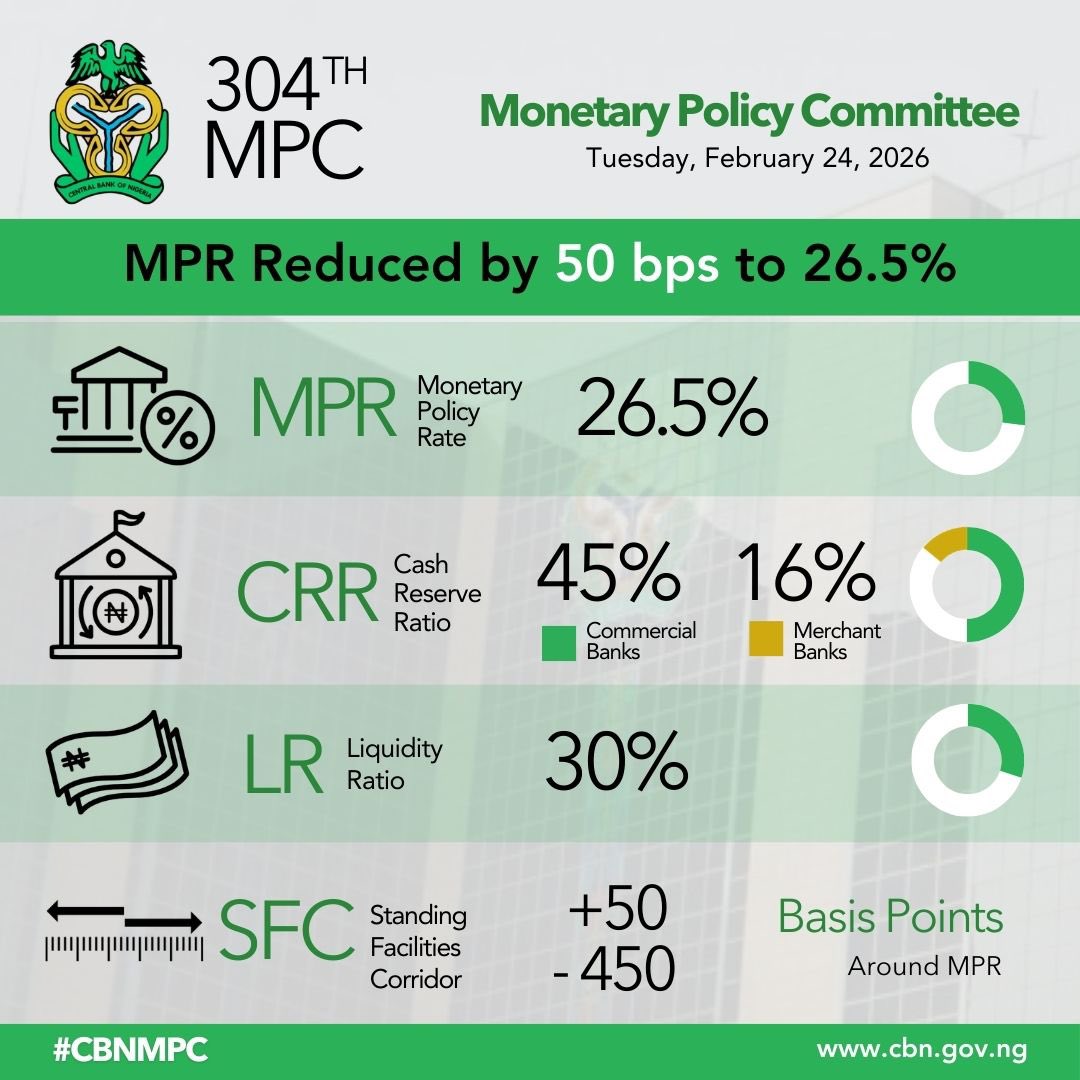
Recall the Central Bank of Nigeria’s Monetary Policy Committee (MPC) reduced the Monetary Policy Rate (MPR) by 50 basis points to 26.50 per cent from 27 per cent, the CBN Governor, Yemi Cardoso, announced.
Cardoso made the disclosure on Tuesday at the 304th MPC meeting in Abuja.
He said the 11 MPC members present also voted to retain the Cash Reserve Ratio (CRR) at 45 per cent for commercial banks and 16 per cent for merchant banks, maintaining current liquidity levels.CBN mops up $190m to slow naira rally
Cardoso added that the Liquidity Ratio remained at 30 per cent, while the Standing Facilities Corridor was retained at +50/-450 basis points around the MPR to guide market stability and financial operations.
Reactions
In a swift response to reduction, the Nigeria Employers’ Consultative Association (NECA) commended the Central Bank of Nigeria (CBN) for reducing the Monetary Policy Rate (MNR).
NECA Director-General, Mr Adewale-Smatt Oyerinde, praised the decision in a statement issued on Tuesday in Lagos.
He noted that the Monetary Policy Committee lowered the MPR from 27.0 per cent to 26.5 per cent at its 304th meeting.
Oyerinde described the 50 basis point cut as “a cautious but noteworthy signal” that authorities were responding to sustained pressures on businesses.
He said the marginal reduction might not immediately lower lending rates, but reflected “a gradual shift toward supporting growth without undermining price stability”.
According to him, the overall stance remained tight, with the Cash Reserve Ratio retained at 45 per cent and the liquidity ratio at 30 per cent.
He added that the asymmetric corridor around the MPR was also maintained, reinforcing a cautious monetary approach.
“With a substantial portion of deposits still sterilised, banks’ capacity to expand credit to the real sector may remain constrained in the near term,” he said.
Oyerinde described the move as “a careful balancing act” aimed at moderating inflation without worsening pressures on businesses.
He noted that firms continued to grapple with high operating costs, exchange rate volatility and weakened consumer demand.
“Inflation, particularly in food, energy and transportation, remains a significant challenge to employers and households,” he said.
He stressed that the modest easing must be supported by coordinated fiscal and structural reforms to address supply-side constraints.
Such reforms, he said, should improve infrastructure and enhance productivity across key sectors of the economy.
Oyerinde urged financial institutions to ensure the MPR reduction was gradually reflected in lending conditions for manufacturers and SMEs.
He affirmed that although the MPC had not fully relaxed its tightening stance, the rate cut signalled cautious optimism.
“Sustained improvements in inflation, exchange rate stability and investor confidence will determine scope for further easing that supports growth and employment,” he said
Also, the Centre for the Promotion of Private Enterprise (CPPE) praised the Central Bank of Nigeria (CBN) for cutting the Monetary Policy Rate by 50 basis points to 26.5 per cent.
According to CPPE, in a policy brief issued on Tuesday in Lagos, the move is growth-supportive.
It said the decision of the Monetary Policy Committee, announced by the CBN Governor, Olayemi Cardoso, reflected improving macroeconomic fundamentals and a cautious shift from aggressive tightening.
The organisation noted that sustained disinflation, stronger external reserves, an improved trade balance and relative exchange-rate stability had created room for monetary easing.
It said the rate cut could boost investor confidence and support private-sector growth, but cautioned that weak monetary transmission might limit its impact on lending rates.
The CPPE identified high cash reserve requirements, elevated lending rates, government borrowing and structural banking costs as major constraints to effective transmission.
The group also stressed the need for fiscal consolidation, citing high public debt, persistent deficits and rising debt-service obligations as risks to macroeconomic stability.
The Chief Executive Officer of CPPE, Dr Muda Yusuf, said effective policy coordination and stronger transmission mechanisms were critical to unlocking investment and sustaining growth.
He commended the CBN for what he described as a measured and data-driven policy adjustment.
The CPPE bods noted that the easing reflected strengthening macroeconomic performance, declining inflation, growing reserves, improved trade balance and enhanced foreign exchange stability.
Yusuf added that for the benefits of monetary easing to be fully realised, authorities must strengthen transmission to ensure lower lending rates for the real sector and advance credible fiscal consolidation to safeguard stability.
He said that if supported by structural reforms and disciplined fiscal management, the current policy direction could unlock a stronger investment cycle and more durable economic growth.
The Chief Executive Officer of Wyoming Capital and Partners, Mr Tajudeen Olayinka said that the decision by MPC to drop MPR by 50 basis points was commendable, in view of numerous headwinds that could create shocks of different magnitudes.
“The committee was mindful of possible impact of a large interest rate cut on foreign portfolio inflows, and so, would not take interest rate decision that could hurt capital importation or disturb exchange rate stability.
“The decision to adjust interest rate to 26.5 per cent is in order. Time will come when interest rate will align with the market, and I think MPC of CBN is waiting for that opportunity to show itself,” he said.
Also speaking, Vice President of Highcap Securities, Mr David Adonri said the rate cut suggested growing confidence by monetary authorities in the economy.
He noted that the move might had been influenced by recent moderation in inflation and appreciation of the naira, indicating a possible shift toward a pro-growth, expansionary monetary policy.
According to him, the MPC may be easing monetary policy on the assumption that fiscal interventions were beginning to address underlying structural imbalances in the economy.
“After the last reduction of MPR before this latest one, there was a spike in inflation rate.
“Perhaps current reduction indicates that the Monetary Authority is confident that prevailing economic factors now warrants relaxing monetary policy.
“This may be justified by the recent moderation in inflation rate and appreciation of the Naira.
“Meanwhile, the downside risks emanating from rural insecurity remains a big threat to inflation and financial stability,” he said.
Investors lose N1.14trn as NGX reacts to MPC decision
But despite the praise by stakeholders, the Nigerian equities market closed in the red on Tuesday, as investors lost N1.141 trillion following sell-offs in large-cap, consumer goods and insurance stocks.
This development triggered massive sell-offs in stocks such as Daar Communications, Tantalizers, BUA Foods, Ellah Lakes, Japaul Gold, and 35 other equities, which dragged overall market performance lower.
The decline followed the outcome of the 304th meeting of the Monetary Policy Committee (MPC) of the Central Bank of Nigeria, which cut the Monetary Policy Rate (MPR) by 50 basis points to 26.50 per cent
Market capitalisation declined by N1.141 trillion, or 0.92 per cent, to close at N124.827 trillion from N125.968 trillion recorded at the previous session.
Similarly, the All-Share Index shed 1,778.95 points, or 0.92 per cent, to close at 194,484.61 compared with 196,263.56 posted on Monday.
The downturn reduced the year-to-date return to 24.98 per cent, while market breadth closed negative with 40 losers against 27 gainers.
Tantalizer and Daar Communications led the losers’ chart by 10 per cent each, settling at N4.86 and N2.25 per share.
BUA Foods shed by 9.99 per cent finishing at N760.60, Ellah Lakes dipped by 9.96 per cent, ending the session at N10.40 while Ja Paul Gold lost by 9.95 per cent, closing at N3.80 per share.
Conversely, Jaiz Bank led the gainers’ chart by 10 per cent, ending the session at N12.76, Infinity Trust trailed by 9.83 per cent, finishing at N19 and FCMB gained by 9.72 per cent, closing at N13.55 per share.
Fortis Global Insurance rose by 9.09 per cent, settling at 72k while Sterling Nigeria increased by 7.50 per cent, closing at N8.60 per share.
A total of 1.14 billion shares worth N53.4 billion were exchanged across 72,218 transactions, compared to 1.3 billion shares valued at N31.5 billion that was traded in 95,091 deals earlier on Monday.
An evaluation of the market activity revealed a 12 per cent decline in volume, 24 per cent drop in deals but 44 per cent growth in value.
Meanwhile, Ja Paul Gold recorded the highest volume of 102 million traded shares for the day.