By Seun Ibiyemi
The Federal Government has expressed readiness to partner with Norway on satellite-based surveillance of Nigerian waters to tackle illegal fishing, protect marine resources and safeguard the livelihoods of local fishermen.**
The Minister of Marine and Blue Economy, Dr Adegboyega Oyetola, disclosed this on Monday when he received Norway’s Ambassador to Nigeria, Svein Baera, during a courtesy visit to his office in Abuja.
Baera, who was accompanied by the Second Secretary for Political and Project Development, Michelle Hovi, introduced the Blue Justice initiative, a programme that provides participating countries with free satellite-based Automatic Identification System (AIS) vessel-tracking data through the Blue Justice Ocean Surveillance Programme.
The initiative is designed to strengthen maritime surveillance by enabling authorities to track vessel movements, identify suspicious activities and detect so-called “dark vessels” that evade conventional tracking systems.
The Norwegian ambassador invited Nigeria to join the Blue Community, a network of countries participating in the initiative to strengthen cooperation against illegal, unreported and unregulated (IUU) fishing and other maritime crimes.
He explained that the programme would provide Nigeria with real-time and historical vessel-tracking data to support investigations, improve maritime monitoring and identify patterns associated with illegal fishing activities.
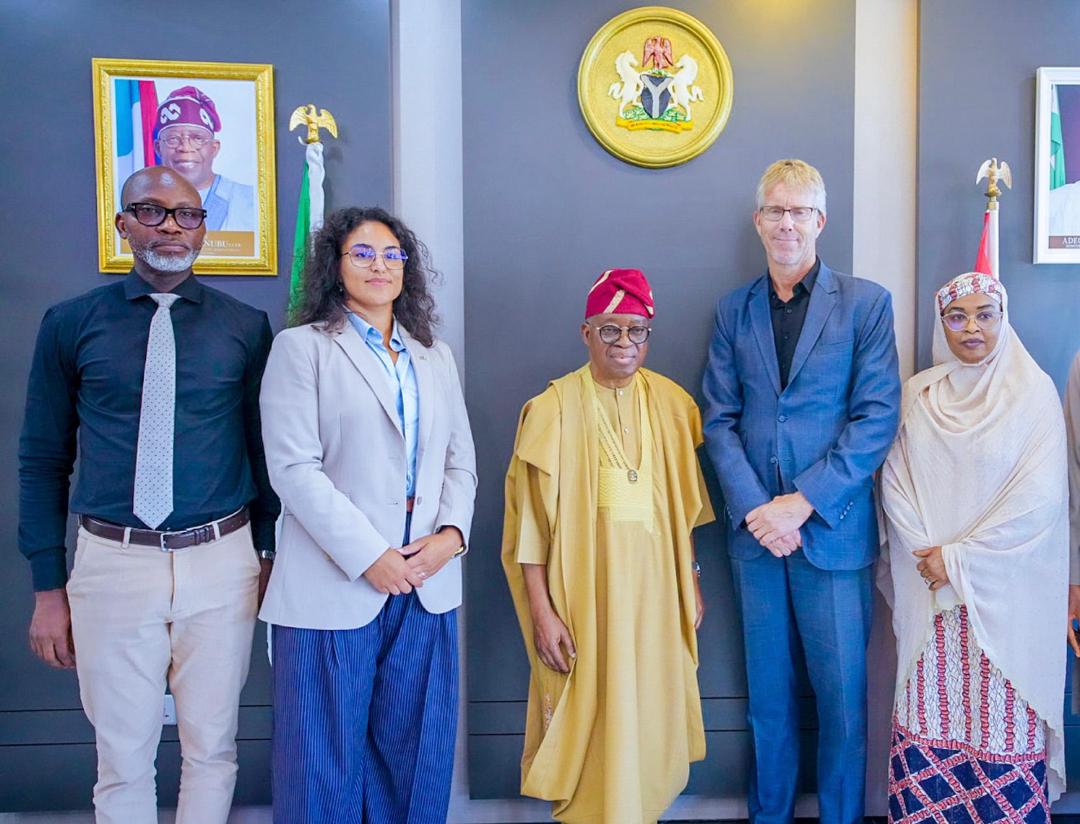
L-R: Senior Special Assistant to the President on Marine and Blue Economy, Professor Busayo Fakinlede; Second Secretary, Norwegian Embassy, Ms. Michelle Hovi; Minister of Marine and Blue Economy, Dr. Adegboyega Oyetola; Norwegian Ambassador to Nigeria, Ambassador Svein Baera; and Permanent Secretary, Federal Ministry of Marine and Blue Economy, Mrs. Fatima Mahmood, during the Ambassador’s courtesy visit to the Minister in Abuja on Monday.
According to him, the initiative would enhance Nigeria’s capacity to protect its fisheries resources and enforce regulations against operators exploiting its waters illegally.
Responding, Oyetola commended the Norwegian government for the initiative and its longstanding collaboration with Nigeria, assuring the delegation that the country was ready to participate in the programme.
The minister expressed concern over the activities of foreign fishing operators who illegally harvest fish from Nigerian waters, with the products subsequently returned to the country and sold to Nigerians at exorbitant prices.
“We cannot continue to allow foreign operators to exploit our marine resources illegally while our local fishers and businesses suffer the consequences. The Federal Government is determined to bring this practice to an end,” he said.
Oyetola warned that illegal fishing undermines the livelihoods of local fishermen, deprives the country of legitimate economic benefits and threatens the sustainable management of its aquatic resources.
He noted that satellite surveillance, supported by improved intelligence sharing, would enhance the government’s ability to identify suspicious vessel movements and strengthen enforcement of fisheries regulations.
READ ALSO:SIFAX Group links business success to customer trust, loyalty, exceptional service
The minister maintained that protecting Nigeria’s waters was both an environmental responsibility and an economic necessity, stressing the need to preserve fish stocks, protect local fishing communities and maximise the contribution of marine resources to national development.
“The protection of our waters is an environmental responsibility and an economic imperative. We must protect our fish stocks, safeguard the livelihoods of our fishermen and ensure that our marine resources contribute meaningfully to national development,” he added.
Oyetola further disclosed that the Federal Government was pursuing measures to increase domestic fish production, reduce dependence on imports, create employment opportunities and conserve foreign exchange.
The proposed partnership with Norway is expected to complement these efforts by improving the monitoring of fishing activities and strengthening the government’s capacity to identify and respond to illegal operations.
Illegal, unreported and unregulated fishing remains a challenge for coastal countries because it can deplete fish stocks, undermine lawful fishing businesses and reduce government revenue from marine resources.
For Nigeria, stronger surveillance could help protect the interests of artisanal fishermen and legitimate fishing operators while supporting the sustainable development of the marine and blue economy.
The proposed collaboration also underscores the importance of international cooperation and technology in addressing maritime challenges that extend beyond national borders.
By leveraging satellite-based vessel-tracking information and strengthening enforcement, Nigeria aims to protect its marine resources, improve local fish production and ensure that the country’s maritime assets deliver greater economic benefits to its citizens.