By Seun Ibiyemi
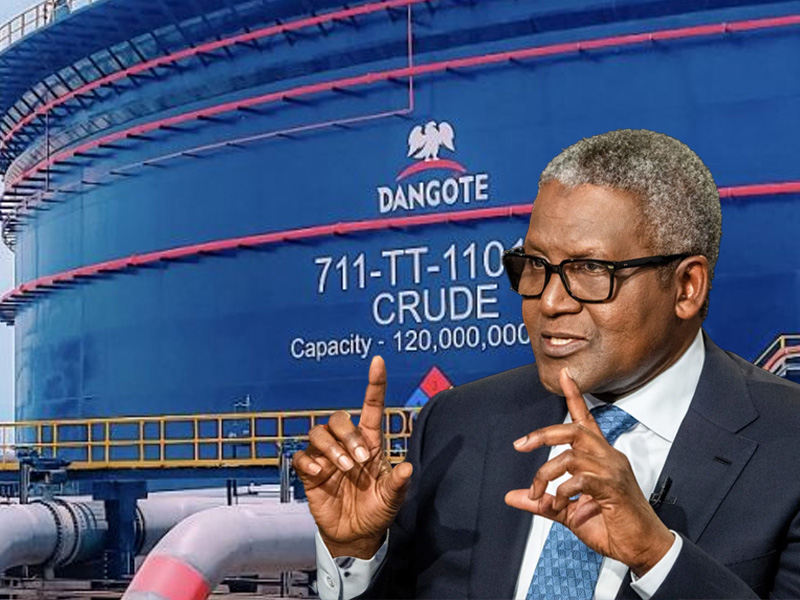
President of the Dangote Group, Aliko Dangote, has announced plans to expand into steel production, electricity generation and port development as part of a sweeping strategy to accelerate industrialisation across Africa.
Dangote, whose conglomerate already operates in cement, sugar, salt, fertiliser and petrochemicals, said the move is aimed at deepening Africa’s manufacturing base beyond oil refining and positioning the continent as a global industrial powerhouse.
His flagship project, the Dangote Petroleum Refinery & Petrochemicals, is currently operational and producing about 650,000 barrels of refined products daily.
Read also:Dangote Group secures $400m Chinese equipment deal to expand refinery, petrochemicals
According to him, output is expected to double within the next three years as expansion plans advance.
However, in a recent interview with The New York Times, Dangote stressed that refining represents only one phase of a broader industrial vision.
“We have to industrialise Africa,” he said, identifying steel manufacturing, expanded electricity access and additional port infrastructure as the next pillars of growth needed to support large-scale production and trade.
Industry analysts note that entry into steel manufacturing would position the group in a sector vital to infrastructure, housing and heavy industry. Investments in power generation and port facilities could also help address longstanding constraints to economic growth in Nigeria, particularly unreliable electricity and logistics bottlenecks.
Dangote cited India’s Tata Group as a model for diversified industrial expansion, describing its multi-sector footprint as proof that large-scale manufacturing can transform emerging economies.
Job creation, he said, remains central to his strategy. With Nigeria projected to require between 40 and 50 million new jobs by 2030, Dangote argued that only large-scale industrial projects can absorb the country’s rapidly growing youth population.
The refinery alone currently employs about 30,000 workers, roughly 80 per cent of them Nigerians. Expansion into new sectors is projected to increase total employment within the group to about 65,000.
Read also:Dangote projects naira could strengthen to N1,100 per dollar in 2026
Dangote also disclosed plans to list shares of the refinery on the Nigerian stock market, a move expected to broaden local participation and deepen capital market engagement.
Despite the progress, he acknowledged persistent infrastructure gaps and crude supply challenges.
He has previously raised concerns about logistics bottlenecks and inefficiencies in the oil value chain that complicate feedstock supply to the refinery.
Nonetheless, Dangote reaffirmed his commitment to aggressive investment in sectors capable of reducing import dependence and retaining economic value within Africa.
“Nobody dared to do it, so we did it,” he said, underscoring his belief that transformative private-sector investment is critical to reshaping Nigeria’s and Africa’s industrial future.
With cement plants spread across multiple African countries and a refinery already redefining Nigeria’s downstream landscape, Dangote’s push into steel, electricity and port infrastructure marks a new phase in his ambition to industrialise the continent.