By Seun Ibiyemi
President Bola Ahmed Tinubu has said his administration’s economic reforms are beginning to reshape Nigeria’s economic outlook, promising to dismantle structural barriers, attract investment, create jobs and deliver shared prosperity.
Tinubu spoke on Monday through Vice-President Kashim Shettima, who represented him at the formal opening of the 32nd Nigerian Economic Summit in Abuja.
The President said his administration had embarked on a difficult economic reset because sustainable growth could not be achieved through shortcuts, stressing that the ultimate objective was to improve livelihoods and expand opportunities for jobseekers, farmers, manufacturers, entrepreneurs and innovators.
“We came to rewrite the story of a nation that has performed below its potential for far too long. But there is no shortcut to economic growth. This is why we began with a difficult reset,” he said.
He added that stabilising the economy was essential to harnessing Nigeria’s growing population and creating the conditions for public and private sector investment, business expansion and productive employment.
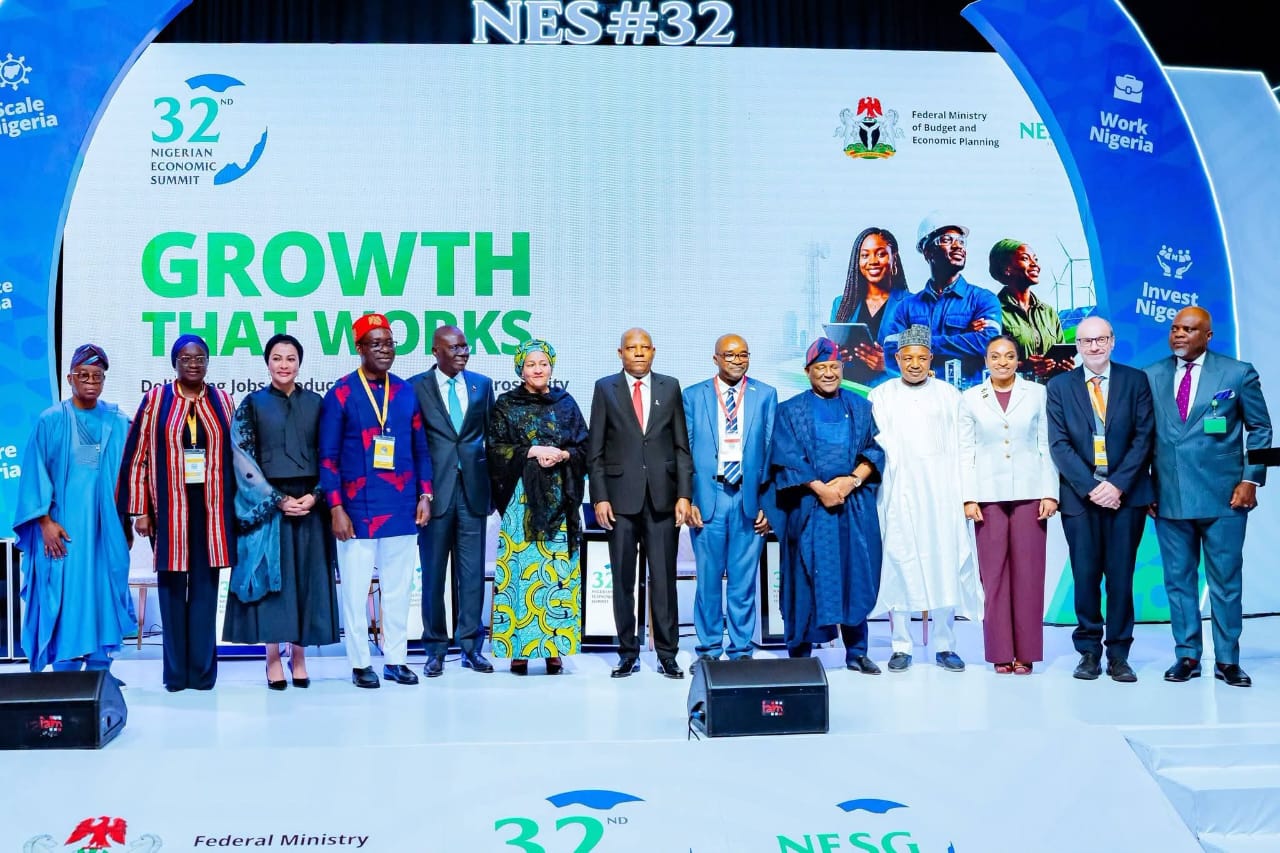
The summit, themed “Growth That Works: Delivering Jobs, Productivity and Shared Prosperity,” builds on the ambition of previous editions to achieve a prosperous and inclusive Nigeria by 2030.
The President said his administration had introduced reforms to remove structural constraints that had prevented the country’s human and natural resources from generating greater prosperity.
According to him, the measures were restoring confidence, strengthening economic foundations and laying the groundwork for sustainable growth.
Citing National Bureau of Statistics figures, Tinubu said Nigeria’s inflation-adjusted gross domestic product grew by 3.89 per cent in the first quarter of 2026, compared with 3.13 per cent in the corresponding period of 2025.
He added that non-oil activities accounted for 96.08 per cent of GDP, while manufacturing grew by 3.29 per cent and the oil sector expanded by 2.57 per cent.
The President said the figures reinforced his administration’s confidence in its economic recovery and diversification agenda, but stressed that progress should be measured by more than headline economic indicators.
He said the government must also improve the quality of employment, reduce underemployment and better utilise the country’s workforce.
“Our pursuit of prosperity demands greater productivity from every worker, enterprise and investment,” he said.
Tinubu argued that infrastructure should be assessed by the economic activity it generates, education by the skills and productivity it delivers, and industrial policies by their impact on business competitiveness.
Tinubu also highlighted an increase in capital importation, saying Nigeria attracted $10.37 billion in the first quarter of 2026, representing an 83.83 per cent increase over the same period in 2025.
He said the figure comprised portfolio and foreign direct investment, adding that the government would continue to ease regulatory burdens, strengthen transparency and improve policy predictability.
The administration, he said, would also work to expand access to finance and implement tax reforms aimed at creating a modern and equitable system that supports development while providing businesses with greater certainty.
Tinubu said the reforms were also being extended to key sectors, including energy, agriculture and solid minerals.
On electricity, he said the government was reforming the market to improve supply and attract investment in generation, transmission, distribution and alternative energy sources.
In agriculture, the administration is seeking to connect farms with storage facilities, processing centres and markets while expanding irrigation, mechanisation, financing and rural infrastructure.
The President added that the government intended to move the solid minerals sector beyond extraction towards domestic processing, industrial production and exports.
READ ALSO:NIMASA, ITF sign MoU to boost Nigerian seafarers’ mental health
The United Nations Deputy Secretary-General, Dr Amina Mohammed, acknowledged gains from the economic reforms but called for their urgent consolidation and stabilisation.
She also emphasised the importance of managing expectations among citizens and other stakeholders as the country navigates the reform process.
Mohammed commended the African Development Bank for its evolving development-financing architecture, particularly its focus on funding programmes designed to deliver tangible development outcomes across the continent.
Her remarks highlighted the importance of ensuring that economic policy changes translate into sustained improvements in living standards and broader development gains.
The Minister of Finance and Coordinating Minister of the Economy, Dr Taiwo Oyedele, presented the proposed Nigerian Economic Policy Framework, describing it as a national economic doctrine for guiding economic decisions and measuring progress.
Oyedele invited members of the Nigerian Economic Summit Group (NESG) and private-sector experts to scrutinise the draft and contribute evidence-based recommendations.
He identified enterprise, open but fair markets, and whole-of-government coherence as key principles underpinning the framework.
Other priority areas include economic stability, human capital development and productivity.
The minister said contributions from business leaders and economic experts would help strengthen the framework and ensure it provides a practical basis for policy decisions.
In his welcome address, NESG Chairman Olaniyi Yusuf said participation in the summit demonstrated stakeholders’ commitment to inclusive and impactful economic growth.
He acknowledged the Federal Government’s efforts to improve the ease of doing business but argued that the priority should now be to stabilise the economic reforms rather than reverse them.
Yusuf said the summit should help move the country from broad policy agreement to practical solutions capable of generating jobs, improving productivity and delivering shared prosperity.
He urged participants to focus on actionable proposals that address the economic challenges confronting businesses and households.
Chairman and Founder of BUA Group, Abdul Samad Rabiu, also commended the Tinubu administration’s economic reforms, saying they had begun addressing longstanding challenges faced by Nigerian businesses.
While acknowledging the difficulties experienced by ordinary Nigerians, Rabiu said improved access to foreign exchange had made the operating environment more predictable for businesses.
“For many years, one of the greatest challenges facing businesses was access to foreign exchange. You could have all the naira but be unable to obtain the foreign exchange needed to buy raw materials and machinery,” he said.
His remarks underscored the importance of foreign exchange availability to manufacturers and other businesses that depend on imported raw materials, equipment and machinery.
The summit brought together government officials, state governors, business leaders and other stakeholders to discuss strategies for translating economic reforms into investment, jobs and higher productivity.
Among those present were Anambra State Governor Chukwuma Soludo, Lagos State Governor Babajide Sanwo-Olu, Minister of Budget and Economic Planning Abubakar Bagudu, Minister of Industry, Trade and Investment Jumoke Oduwole, and Minister of Livestock Development Idi Mukhtar Maiha.
The central challenge emerging from the discussions is how to sustain macroeconomic reforms while ensuring that improved economic indicators translate into stronger business activity, productive employment and better living conditions for Nigerians.