By Seun Ibiyemi
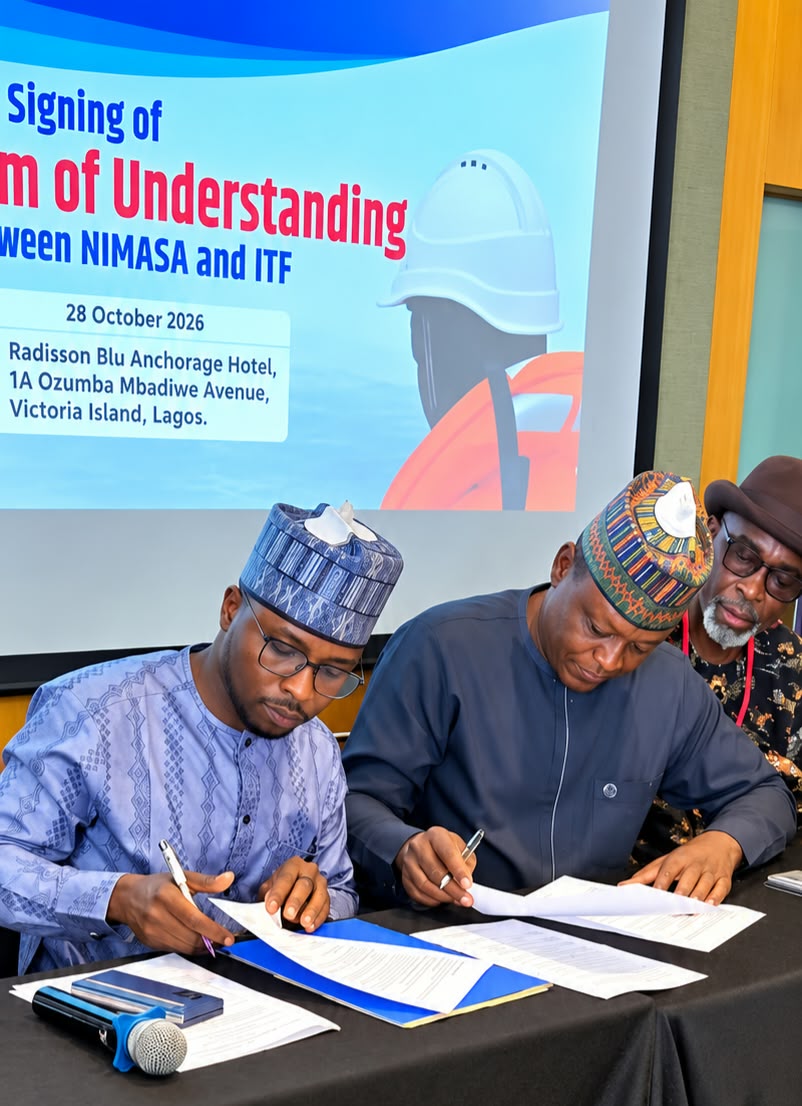
The Nigerian Maritime Administration and Safety Agency (NIMASA) has signed a Memorandum of Understanding (MoU) with the International Transport Workers’ Federation (ITF) to strengthen mental health support and improve the wellbeing of Nigerian seafarers and cadets.
The agreement is designed to promote training, awareness and capacity building, with plans to integrate seafarers’ wellbeing into maritime training curricula and make mental health support a permanent feature of preparations for life at sea.
The MoU was endorsed at the end of a three-day Seafarers’ and Cadets’ Wellbeing Awareness and Train the Trainers Programme, organised by NIMASA in collaboration with the ITF under the theme, “Stress: Understanding, Early Management and Coping.”
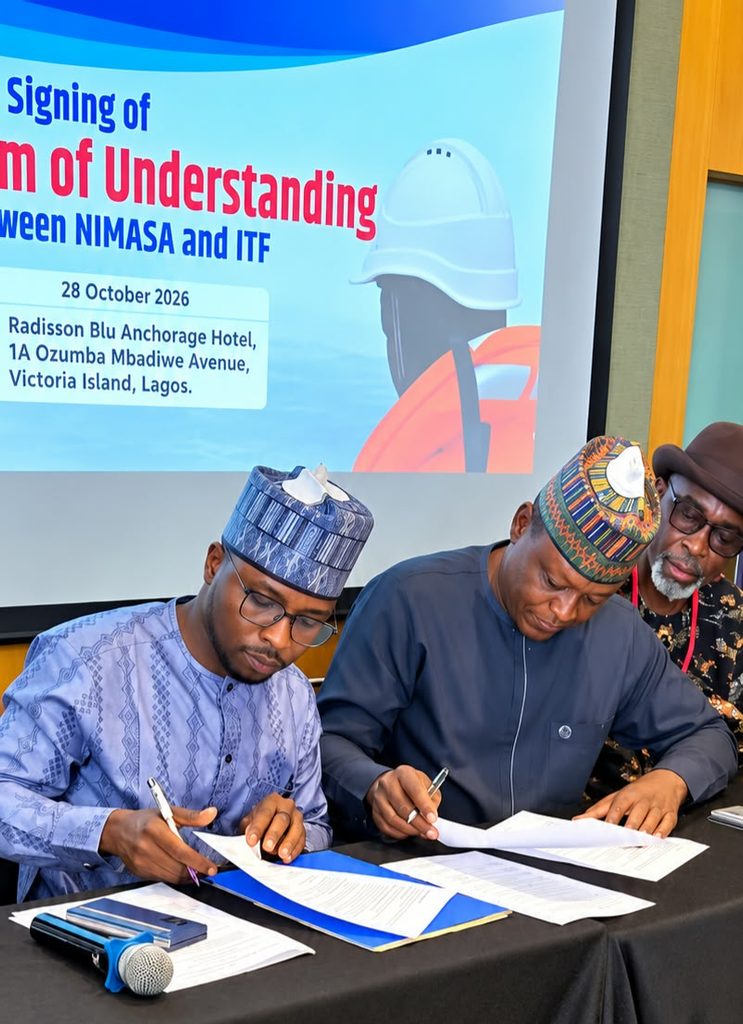
Jibril Abba, Executive Director, Maritime Labour and Cabotage Services, Nigerian Maritime Administration and Safety Agency, NIMASA (left) and Safiyanu Dauda Mohammed, Africa Regional Secretary, International Transport Workers Federation (ITF) endorsing the MoU on Promotion of mental health and wellbeing of Nigerian seafarers.
Speaking at the event, NIMASA Director-General, Dr Dayo Mobereola, said the partnership would equip maritime training institutions, agency officials and union representatives with the knowledge and skills to identify and manage stress among seafarers.
Mobereola, who was represented by the Executive Director, Maritime Labour and Cabotage Services, Mr Jibril Abba, said seafarers’ wellbeing was essential to safe shipping and reaffirmed the agency’s commitment to protecting maritime workers.
“This programme would equip maritime training institutions, Agency officers and union partners with the skills to identify and manage stress and provide psychological first aid when necessary,” he said.
The Director-General highlighted the psychological challenges associated with working at sea, including stress, anxiety, depression and burnout, particularly among workers who spend extended periods away from their families.
Citing a 2019 study commissioned by the ITF in collaboration with Yale University, Mobereola noted that one in four seafarers surveyed showed signs of depression, while approximately one in six exhibited signs of anxiety.
He said the findings underscored the need for sustained interventions to improve mental health awareness, early identification of psychological distress and access to appropriate support within the maritime industry.
The ITF Africa Regional Secretary, Mr Safiyanu Dauda Mohammed, described the agreement as a significant milestone, saying it was the first MoU of its kind the federation had entered into with a country in Africa.
READ ALSO:Ogun Police secure conviction of man over Counterfeit Coleman Electrical cables
“It is very exciting for me because it is the first in Africa, and we are starting with Nigeria,” Mohammed said.
He stressed that seafarers were critical to the maritime sector and that their welfare and mental wellbeing must be prioritised to help mitigate anxiety and depression.
The President-General of the Maritime Workers Union of Nigeria, Comrade Francis Bunu, also welcomed the partnership, describing it as an important development for Nigerian seafarers.
“We need seafarers to be mentally sound while doing their job and that is why today is a very significant day for the seafarer in Nigeria,” Bunu said.
Other stakeholders at the event included the National President of the Nigerian Merchant Navy Officers and Water Transport Senior Staff Association, Chief Engineer Bob Joseph Yousou; ITF Wellbeing Coordinator, Dr Asif Altaf; and ITF Inspector, Mr Hamani Amadou.
The programme comes amid growing recognition of the mental and emotional pressures faced by seafarers, whose work often involves demanding conditions, prolonged periods at sea and separation from loved ones.
Through the partnership, NIMASA and the ITF aim to strengthen institutional cooperation and build the capacity of maritime stakeholders to promote early stress management, psychological first aid and improved welfare for seafarers and cadets.
The collaboration reinforces the principle that protecting seafarers’ mental health is an important part of improving safety and wellbeing across the maritime industry.