By Seun Ibiyemi
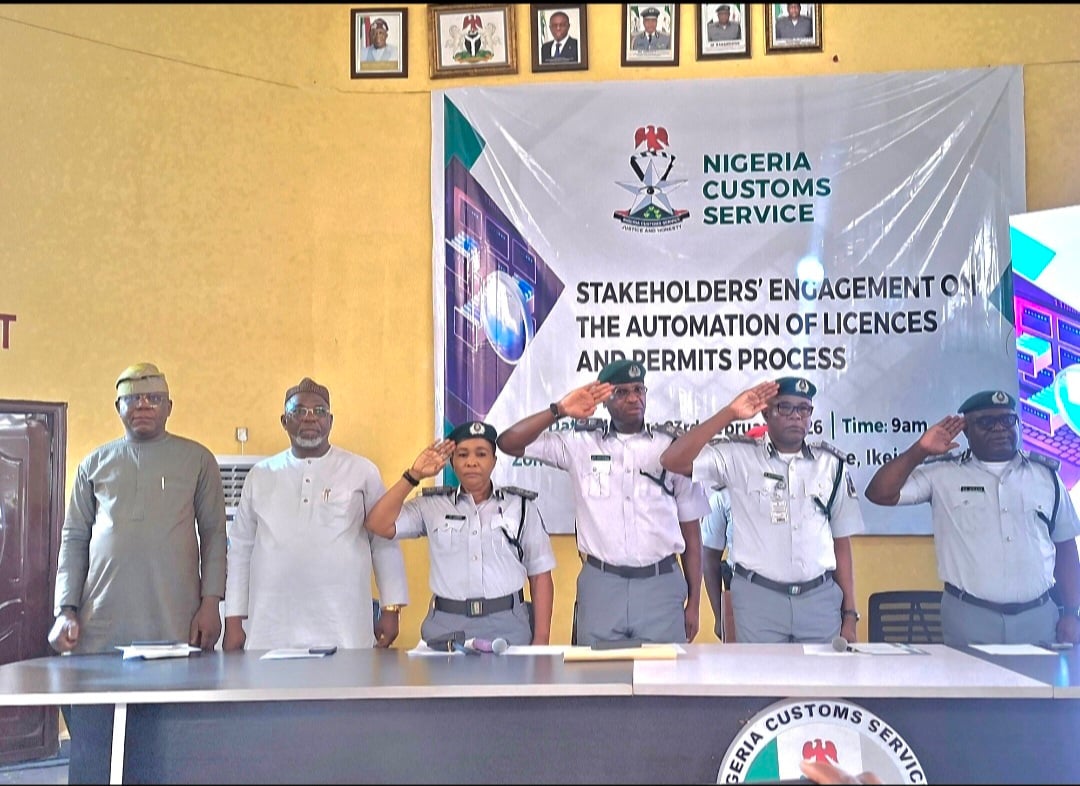
The Nigeria Customs Service (NCS) on Monday commenced the sensitisation of clearing agents on the full automation of its Licences and Permits application processes, in a move aimed at enhancing efficiency, transparency, and ease of doing business.
Speaking during the sensitisation programme in Lagos, the Deputy Comptroller-General of Customs (DCG) Tariff & Trade, C.K. Niagwan represented by the Zonal Coordinator, Zone A, Mohammed Babandede said the automation initiative was approved by the Comptroller-General of Customs, Bashir Adewale Adeniyi, as part of efforts to modernise Customs operations.
Babandede explained that the reform was a direct response to longstanding concerns over paperwork, delays, and inefficiencies associated with manual processing.Customs hands over 1,650 jerrycans of PMS worth N40.7m to NMDPRA
“For many years, stakeholders have had to deal with paperwork, long queues, and the uncertainty that comes with manual processing. Those days are coming to an end,” he said.
According to him, the sensitisation exercise is being held across all zones to ensure that stakeholders fully understand the new automated system before its implementation.
He noted that under the new regime, clearing agents and importers would be able to apply for and renew licences and permits remotely, without physically visiting Customs offices.
“It means your applications will be processed faster. It means you will be able to track the status of your application in real time. And it means that the process will be the same for everyone fair, consistent, and without the risk of error that comes with manual records,” Babandede stated.
He added that automation would also improve record-keeping, supervision, and service delivery within the Service, enabling officers to manage higher volumes of transactions without additional strain.AEO scheme boostts Customs revenue by ₦362.79bn, cuts cargo clearance time by 75%
Describing Lagos as the commercial heartbeat of Nigeria, Babandede stressed the importance of successfully implementing the initiative in Zone A, the most economically active zone in the country.
Also speaking, the Comptroller of Customs in charge of the Licences and Permits Unit, Ngozika Anozie, highlighted the cost-saving and operational benefits of the new system.
She said automation would eliminate the need for stakeholders to travel to Abuja to process licences and permits, thereby reducing transportation, accommodation, and other incidental expenses.
Anozie further explained that the system would automatically reject fake documents while accepting genuine ones, thereby minimising fraudulent practices.
She disclosed that the Licences and Permits Unit would now leverage the B’Odogwu system to monitor assessments and ensure that companies applying for fresh licences or renewals have no outstanding obligations.
“Automation saves time. ‘Time na money’ is a popular saying, and it is especially true in this instance,” she said, noting that the reform would ultimately enhance the Service’s statutory revenue-generation functions.
Stakeholders present at the event included leaders of the Association of Nigerian Licensed Customs Agents (ANLCA) and the National Association of Government Approved Freight Forwarders (NAGAFF), among others, who were urged to cascade information about the new system to their members to ensure a smooth transition.