
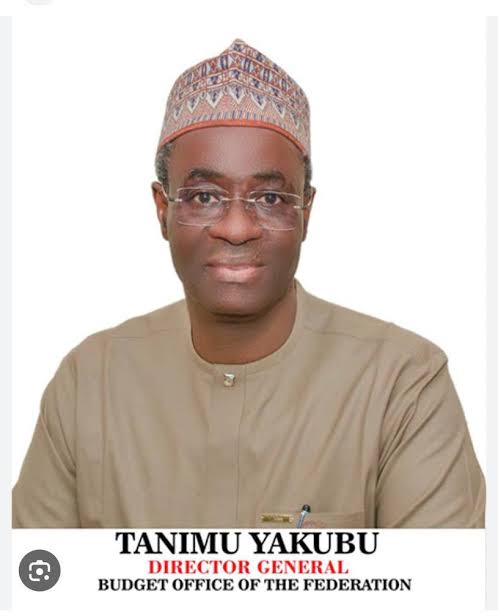
By Seun Ibiyemi
The Director-General of the Budget Office of the Federation, Tanimu Yakubu, has said that the removal of fuel subsidy and other price distortions does not create an immediate fiscal windfall for Nigeria, but rather corrects systemic inefficiencies and improves long-term public finance sustainability.
Yakubu stated this in a fiscal policy paper titled “A Fiscal Rejoinder: Reform Is Not a Windfall – Restoring Revenue Integrity, Correcting Price Distortions, and Rebuilding Nigeria’s Fiscal Capacity,” where he argued that subsidy removal should not be mistaken for instant liquidity for government spending.
According to him, the widespread belief that subsidy removal automatically generates cash for discretionary expenditure is fundamentally flawed and analytically indefensible.
“Subsidy removal does not create liquidity. It eliminates a distortion. It corrects a mispricing. It improves the trajectory of public finance. But it does not, in itself, generate a stock of cash available for discretionary expenditure,” he stated.
He explained that Nigeria’s subsidy challenge extends beyond petrol pricing and includes foreign exchange management and electricity tariffs, all of which represent different forms of underpricing of scarce economic resources.
Yakubu noted that artificially low exchange rates act as implicit subsidies on imports and privileged access to foreign exchange, while underpriced electricity tariffs create market shortfalls that require continuous government intervention and budgetary support.
He stressed that removing such subsidies only reveals and reallocates fiscal burdens within the system rather than eliminating them.
The Budget Office boss said Nigeria’s deeper fiscal problem lies in poor revenue capture, recognition, and constitutional routing, rather than a simple absence of revenue.
He pointed to what he described as systemic fiscal leakages through underpricing, discretionary concessions, opaque contracts, netting at source, institutional retention practices, off-budget spending, delayed remittances, and classification distortions.
“At the core of Nigeria’s fiscal challenge lies a deeper issue: the system does not fully capture the revenue it generates,” he said.
Yakubu also highlighted what he called a structural imbalance in Nigeria’s fiscal federalism, where revenues are shared through the Federation Account while major obligations such as debt servicing, exchange rate stabilization, and quasi-fiscal burdens remain concentrated at the federal level.
He said this asymmetry creates a situation where subnational governments benefit from increased distributable revenue, while the Federal Government bears the burden of macroeconomic correction and fiscal stabilization.
READ ALSO: COWA launches nationwide campaign to plant 1,000 trees in one hour
According to him, this weakens collective ownership of reforms and places persistent pressure on federal solvency.
He described Executive Order 9 of 2026 as a major step toward restoring fiscal integrity by ensuring that all public revenues pass through the constitutional fiscal chain.
The order, he said, seeks to eliminate unauthorized netting, institutional retention practices, and quasi-fiscal opacity by enforcing proper remittance to the Consolidated Revenue Fund and the Federation Account before distribution.
Yakubu maintained that Nigeria’s path to fiscal stability lies in eliminating price distortions across fuel, foreign exchange, and electricity, while strengthening revenue capture mechanisms and aligning fiscal responsibility with revenue sharing.
He said true fiscal expansion would come not from perceived windfalls, but from building a functional fiscal state capable of recognizing, governing, and deploying its full financial capacity.