By David Oluwatosin
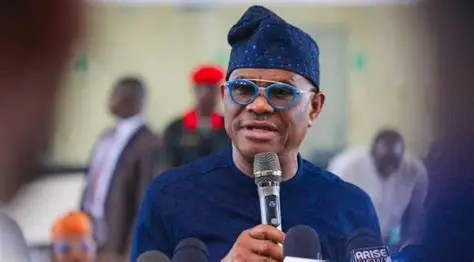
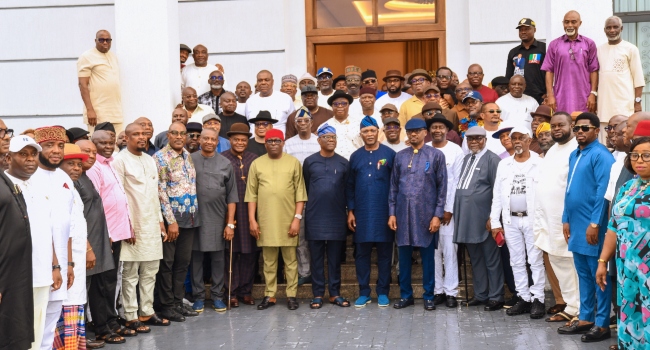
The Minister of the Federal Capital Territory, Nyesom Wike, on Sunday led members of the Rivers State House of Assembly and chairmen of the state’s 23 local government areas to a meeting with Governor Siminalayi Fubara at his private residence in Port Harcourt, in what appears to be a renewed push to consolidate reconciliation between the state’s rival political camps.
The meeting, which also involved the Speaker of the House of Assembly, Martin Amaewhule, and the All Progressives Congress (APC) standard-bearer for the 2027 general elections in the state, Kingsley Chinda, came about a fortnight after Wike led members of the Rainbow Coalition to an earlier engagement with the governor.
Sunday’s visit marked the first time the FCT minister had visited Fubara at his Port Harcourt residence, adding significance to the latest engagement between the two political camps following more than two years of acrimony and political uncertainty in Rivers State.
Although details of the closed-door meeting were not immediately available, sources said the discussions were intended to build on previous engagements, strengthen reconciliation efforts and explore ways to accommodate Fubara’s loyalists in the state’s evolving political arrangement.
The gathering brought together major political figures associated with the prolonged crisis, including the governor, legislative leaders and local government chairmen aligned with Wike, signalling continued engagement between the previously divided camps.
The latest meeting comes against the backdrop of a bitter political dispute between Fubara and his predecessor, Wike, which escalated into a confrontation involving the governor and the Amaewhule-led House of Assembly.
The disagreement, which began in 2023, divided the state’s political establishment and raised concerns about governance, legislative relations and the stability of one of Nigeria’s most strategically important oil-producing states.
At the height of the crisis, lawmakers made two attempts to impeach Fubara, deepening the confrontation between the executive and legislative arms of government.
The dispute also resulted in a division within the state legislature, with rival factions contesting the legitimacy of leadership and control of the Assembly.
In October 2023, amid heightened tensions between the opposing camps, a section of the Rivers State House of Assembly complex along Moscow Road was bombed.
The crisis subsequently raised wider security concerns, particularly after suspected militant groups threatened to attack oil installations in the state.
The political confrontation attracted the attention of President Bola Tinubu, who intervened in an effort to restore stability.
In March 2025, Tinubu declared a state of emergency in Rivers State for an initial period of six months, following the prolonged political crisis.
The measure led to the suspension of Fubara, his deputy and members of the state House of Assembly.
Tinubu appointed Ibok-Ete Ibas as administrator to oversee the affairs of the state during the emergency period.
The intervention generated considerable political debate, particularly over its implications for democratic governance and the constitutional relationship between federal and state authorities.
The elected officials subsequently returned to office after the emergency administration ended, reopening the political space for renewed negotiations between the rival camps.
Sunday’s meeting represents another stage in those efforts, bringing together the governor and key political figures whose disagreements had previously threatened the stability of the state.
Wike’s decision to lead a delegation comprising lawmakers and all 23 local government chairmen underscores the significance of the political structures associated with the FCT minister in the reconciliation process.
The participation of Amaewhule and other members of the Assembly is particularly notable given the legislature’s central role in the confrontation with Fubara.
The involvement of the council chairmen also broadens the engagement beyond the state executive and legislature, bringing local government leadership into discussions about the state’s political future.
Chinda’s presence adds another dimension to the talks, given his position as the APC’s standard-bearer for the 2027 general elections in Rivers State.
However, the precise agenda of the meeting and the terms of any understanding reached between the participants remain unclear.
It is also uncertain whether the discussions produced concrete agreements on political representation, legislative cooperation or the distribution of influence among the rival camps.
With the 2027 general elections approaching, the renewed engagement could have implications for political alignments, candidate selection and the future relationship between Fubara and influential political actors in the state.
Rivers State remains strategically important because of its oil and gas assets, economic significance and role in national politics.
A more stable relationship between the governor and the legislature could improve cooperation on governance and reduce the risk of another prolonged institutional confrontation.
READ ALSO:FG disputes World Bank’s debt assessment, defends ₦7.7trn interest payments
However, reconciliation may depend on how competing interests are managed, particularly demands for political accommodation by Fubara’s supporters and the influence exercised by Wike’s allies within the legislature and local governments.
The emergence of Chinda as the APC’s candidate for the 2027 election also places electoral considerations within the broader political calculations surrounding the talks.
Whether the engagement will lead to a durable political settlement, or merely provide a temporary accommodation between competing interests, remains to be seen.
Sunday’s meeting has brought together several of the principal actors in Rivers State’s political crisis, creating another opportunity to reduce tensions and establish a more workable relationship between the state’s political institutions.
Nevertheless, the absence of publicly disclosed details makes it difficult to determine the extent of progress achieved or the concessions, if any, made by the parties.
The question of how Fubara’s loyalists will be accommodated in the emerging political arrangement is also unresolved, as are broader concerns about political influence, party structures and the selection of candidates ahead of the next elections.
For now, the meeting signals continued engagement between Fubara and the political bloc associated with Wike. Whether that engagement translates into lasting reconciliation will depend on the implementation of any understandings reached and the willingness of the rival camps to sustain cooperation beyond their immediate political interests.