President Bola Ahmed Tinubu has assured oil and gas workers that Nigeria’s refineries will be restored to full and sustainable operations, stressing that the facilities must become profitable and deliver value to Nigerians.
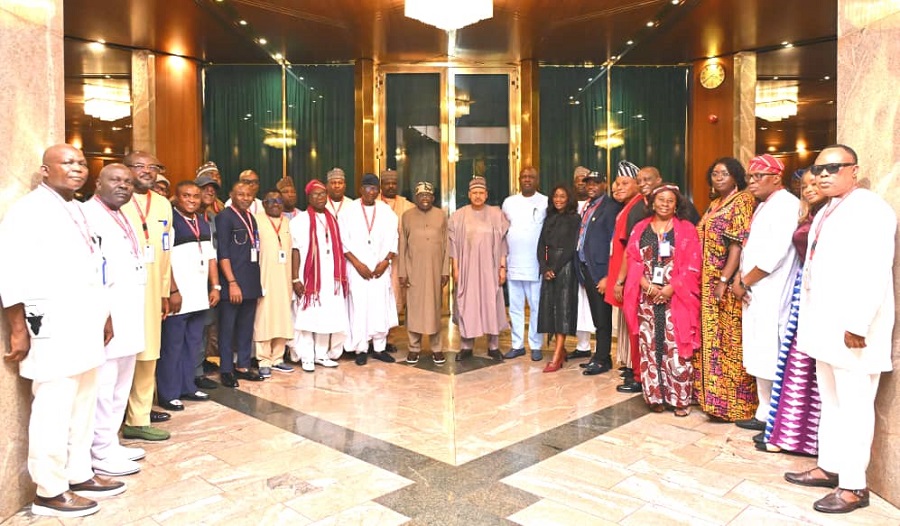
Tinubu gave the assurance on Thursday at the State House, Abuja, while receiving the newly elected leadership of the Nigeria Union of Petroleum and Natural Gas Workers (NUPENG), led by its Executive President, Salimon Akanni Oladiti.
The President, who was conferred with the Grand Patron of NUPENG award during the visit, said his administration had accepted responsibility for fixing the country’s refineries and would not shift the blame to previous governments.
According to him, the government is undertaking a structural and economic reset of the refinery assets to ensure they operate sustainably.
“The refineries that you mentioned are going to come back to work. We’re just building a very firm reset and structural reworking of the economy of it,” Tinubu said.
He stressed that the mere presence of flames and smoke from a refinery does not necessarily indicate that it is functioning effectively, noting that the facilities must operate profitably and provide the value for which they were established.
“I’ve accepted the asset and liability of my predecessors, no matter what has happened in the years past. It’s my responsibility now as the president to fix, make it work for the largest common value of our population. I take responsibility for that, and I’m going to do it,” he added.
The President also defended the removal of petrol subsidy, recalling that he had informed organised labour before the 2023 election of his determination to implement the policy despite possible resistance.
He said the reform had strengthened the ability of the three tiers of government to meet their financial obligations and fund infrastructure and development projects.
Tinubu said the government would soon publish details of how resources accruing from subsidy removal had been utilised.
He cited projects including the Lagos-Ibadan, Abuja-Kaduna, Abuja-Kano and Sokoto-Badagry highways as examples of infrastructure being funded under the administration.
The President also highlighted the introduction of Compressed Natural Gas (CNG) as an alternative to petrol, but expressed concern that the savings from lower operating costs were not being passed quickly enough to commuters.
He urged transport operators to ensure that Nigerians benefit from the reduced cost of running CNG-powered vehicles.
Earlier, NUPENG President Oladiti urged the President to intervene in the growing practice of casualisation of workers, particularly in the upstream oil and gas sector.
He said the union and the Petroleum and Natural Gas Senior Staff Association of Nigeria (PENGASSAN) had exercised restraint because of the strategic importance of the sector and the potential economic consequences of industrial action.
Oladiti said engagements with some affected companies had failed to produce the desired results and appealed to Tinubu to use his office to end the practice.
READ ALSO:2026 Osun Poll: Accord party withdraws support for Adeleke, endorses APC candidate, Oyebamiji
NUPENG also commended the administration’s efforts to revive the Warri and Port Harcourt refineries through partnerships with Chinese firms.
The union, however, urged the government to extend the rehabilitation programme to the Nigerian Pipelines and Storage Company (NPSC) depots across the country.
Oladiti suggested that the depots could be handed over to private investors under equity arrangements to strengthen the distribution of petroleum products.
He also urged the President to ensure compliance by state governments with the Supreme Court judgment granting financial autonomy to local governments.
The NUPENG leadership further commended the Federal Government’s ongoing rehabilitation and dualisation of federal highways, saying improved roads would reduce accidents, product spillages and fatalities involving petroleum tanker drivers.
The Minister of Information and National Orientation, Mohammed Idris, who attended the meeting, commended the growing partnership between the Federal Government and organised labour, saying dialogue was increasingly replacing confrontation in government-labour relations.