By David Oluwatosin
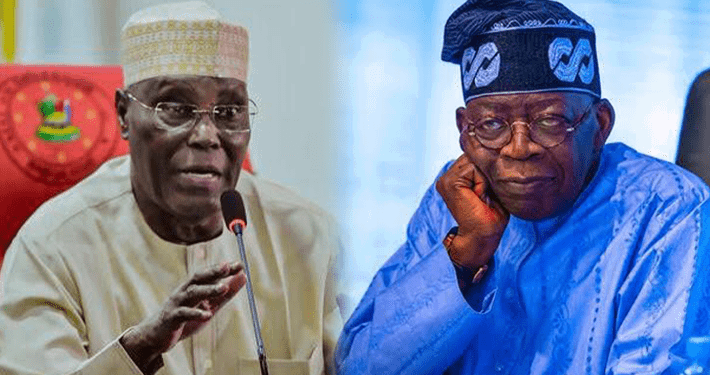
President Bola Tinubu and former Vice President Atiku Abubakar have exchanged accusations over Nigeria’s economic hardship, with both politicians trading blame for rising poverty and hunger as political activities ahead of the 2027 presidential election gather momentum.
Tinubu, who launched his 2027 presidential campaign in Kaduna on Saturday, accused past political leaders, particularly Atiku, the African Democratic Congress (ADC) presidential candidate, of contributing to the economic challenges Nigerians currently face.
Addressing a crowd of party supporters, governors and senior government officials, the President said his administration was working to eradicate poverty, while accusing opposition politicians of exploiting hunger and hardship for political gains.
“I hear my opponents talking about hunger and poverty. Who created it? They did. They created the hunger; they created the poverty. We are trying to eradicate it,” Tinubu declared.
The President’s remarks appeared directed at Atiku, who served as vice-president between 1999 and 2007, a period during which the Federal Government implemented privatisation policies that affected several state-owned enterprises.
The administration also said it had been paying outstanding gratuities and pensions owed to workers affected by the privatisation exercise.
Tinubu, however, promised Nigerians sustained prosperity and stability if re-elected for a second term, urging voters in Kaduna State to support his administration based on its record and investments in critical infrastructure.
He thanked the people of Kaduna for supporting him in the 2023 presidential election and appealed for their renewed mandate in 2027.
As part of his visit, the President performed a symbolic ribbon-cutting ceremony for an 81-kilometre section of the Abuja-Kaduna highway. He also highlighted Kaduna’s historical importance as a political and administrative centre in northern Nigeria.
Responding to the President’s allegations, Atiku accused Tinubu of attempting to deflect responsibility for the economic difficulties Nigerians have experienced under the All Progressives Congress-led administration.
In a statement issued by Phrank Shaibu, Director of Strategic Communication of the ADC Presidential Campaign Council, the former vice-president said the President should account for his government’s policies rather than blame opposition politicians for public hardship.
“Mr President, blaming the opposition for hunger is either delusion or a staggering case of political amnesia. The APC governed Nigeria for eight years before you took office. You have added another three and a half years,” Atiku said.
He added that Nigerians knew which party had been in power and insisted that the country’s economic difficulties could not be attributed to opposition criticism.
“The hardship your administration has brought upon Nigerians is real. You cannot deny it by blaming others,” the statement added.
Atiku also questioned the President’s decision to inaugurate the Abuja-Kaduna highway section, describing the ceremony as disconnected from the concerns of ordinary Nigerians.
“Your decision to commission the unfinished Abuja to Kaduna Expressway from inside a stadium shows how far removed you are from the daily reality of Nigerians. A road cannot be completed with a speech or a ribbon-cutting ceremony,” he said.
The ADC candidate challenged Tinubu to explain the economic consequences of his administration’s policies, particularly the removal of petrol subsidies and the depreciation of the naira.
Atiku asked which administration removed the petrol subsidy and presided over the naira’s decline from about ₦471 to the dollar to approximately ₦1,329, citing the exchange-rate figures in his statement.
He also referenced a World Bank estimate that 63 per cent of Nigerians could be living below the national poverty line in 2026, arguing that the administration should take responsibility for the country’s economic direction.
The former vice-president further criticised the government’s budget implementation, questioning the extension of the 2024 budget into 2025 alongside the operation of a separate 2025 budget.
He also raised questions over reported spending of ₦7.13 trillion under “energy security” in 2024 and ₦11.2 trillion in NNPC pipeline-related expenditure, demanding greater transparency over how the funds were spent and what they delivered.
READ ALSO:Customs rehabilitates healthcare centre in Modakeke to boost access to medical services
Atiku additionally cited what he described as a $12.4 billion gap in Nigeria’s external accounts for the first half of 2026 and questioned a reported $22.5 million in “other charges” associated with an Abu Dhabi financing facility.
The claims and figures cited by the ADC campaign were presented as challenges to the administration and were not independently verified in the statement.
Beyond the economy, Atiku accused the Tinubu administration of failing to adequately address killings, kidnappings and displacement affecting communities across the country.
He argued that insecurity remained a major concern for Nigerians and questioned why the government was focusing on blaming political opponents rather than addressing the challenges.
“These are the questions Nigerians are asking while your government blames the opposition,” he said.
The ADC candidate maintained that the government should be judged by the living conditions of citizens rather than its explanations at political rallies.
“You cannot govern for three years, make life harder, and then blame others for describing the hardship. You asked who created the hunger. Nigerians are asking what you have done to end it,” Atiku stated.
He described the 2027 presidential election as a referendum on Tinubu’s record, insisting that voters would assess the administration based on their experiences in their homes, markets and communities.
The exchange underscores the growing prominence of economic hardship, poverty, exchange-rate pressures and insecurity in the emerging contest ahead of the 2027 presidential election.
While Tinubu has defended his administration’s efforts to improve economic conditions and expand infrastructure, Atiku has called for accountability over the effects of government policies on households and businesses.
The dispute also reflects a broader political debate over responsibility for Nigeria’s economic challenges, with the ruling party pointing to the legacy of previous administrations and the opposition demanding that the incumbent government account for its own policy decisions.
With both camps sharpening their messages, the economy is expected to remain a central issue in the political contest as Nigerians assess the government’s performance and the alternatives presented by opposition parties.