Nigeria’s solid minerals sector has received a major boost following the discovery of what the Federal Government describes as a world-class polymetallic mineral province in Kaduna State, a development expected to strengthen the country’s position as a leading destination for strategic mineral investments.
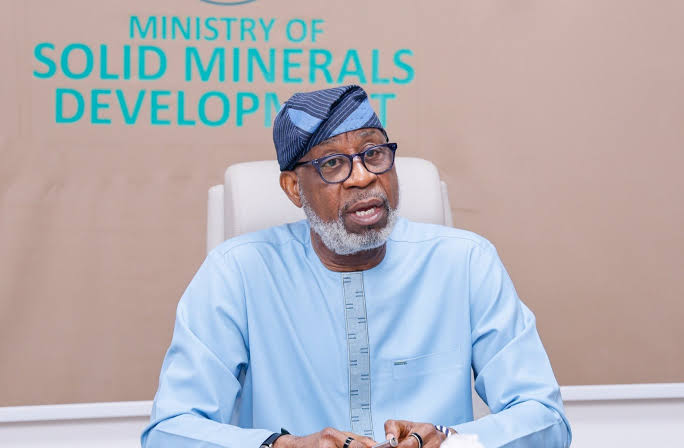
Minister of Solid Minerals Development, Dr. Dele Alake, disclosed this at the 5th African Natural Resources and Energy Investment Summit (AFNIS) held at the Presidential Villa in Abuja, where he said recent geological exploration had uncovered significant deposits of gold, nickel, copper, lithium and other critical minerals of exceptionally high grade.
According to the minister, the discovery has the potential to unlock a mineral economy valued at over $20 trillion and serve as a new engine for economic growth, industrialisation and job creation.
“Recent exploration breakthroughs have confirmed a world-class polymetallic mineral province in Kaduna State, with major deposits of gold, nickel, copper, lithium and rare elements of exceptionally high grade,” Alake said.
He noted that findings verified by the Nigerian Geological Survey Department have further reinforced Nigeria’s status as a key player in the global race for critical minerals needed for energy transition technologies and advanced manufacturing.
Alake revealed that the sector has recorded remarkable growth under the current administration, with its value rising from about $6 billion in 2023 and projected to exceed $17 billion by the end of 2025.
The minister attributed the growth to reforms aimed at repositioning the sector from a raw mineral export-driven model to one focused on local value addition, processing and industrial development.
He stressed that Nigeria is abandoning the long-standing practice of exporting raw minerals, insisting that investors must now process and add value to mineral resources before export.
“The old model where raw minerals were exported and returned as expensive finished products created little prosperity for our people.
Our objective is to retain more value within Nigeria through processing, technology transfer, manufacturing and job creation,” he said.
Alake highlighted several large-scale investments already attracted to the sector, including a $1 billion iron ore project, a $900 million lithium processing investment, a $600 million lithium processing factory in Nasarawa State and a completed $200 million lithium processing facility awaiting commissioning.
The minister also reiterated the government’s commitment to sanitising the mining industry, disclosing that more than 10,000 dormant mineral titles had been revoked to discourage speculation and free up assets for genuine investors.
“We have focused on restoring discipline in the sector, strengthening compliance and improving transparency.
The revocation of over 10,000 inactive licences is part of that effort,” he said.
On regional cooperation, Alake called for stronger collaboration among African countries to maximise the continent’s vast mineral wealth and drive industrial transformation.
His remarks came shortly after President Bola Tinubu signed and presented Nigeria’s instrument of ratification for the African Mineral Strategy Group (AMSG) Charter.
READ ALSO:FG borrowing from banks jumps 75.6% to N40.38trn
The Minister urged stakeholders to ensure that discussions at the summit translate into tangible investments and industrial projects capable of creating jobs and boosting economic growth.
Also speaking, AMSG Secretary-General, Moses Michael Engadu, said Africa possesses the resources required for industrial transformation if countries work together to harness them effectively.
Representatives of the National Assembly, including Chairman of the Senate Committee on Solid Minerals Development, Senator Ekong Sampson, and Chairman of the House Committee on Solid Minerals, Jonathan Gaza, pledged legislative support for policies aimed at strengthening the mining sector and protecting the continent’s mineral resources.
They stressed that the solid minerals sector remains critical to economic diversification and sustainable development across Africa.