… As CPPE blames Middle East tensions for rise in May inflation
By Seun Ibiyemi
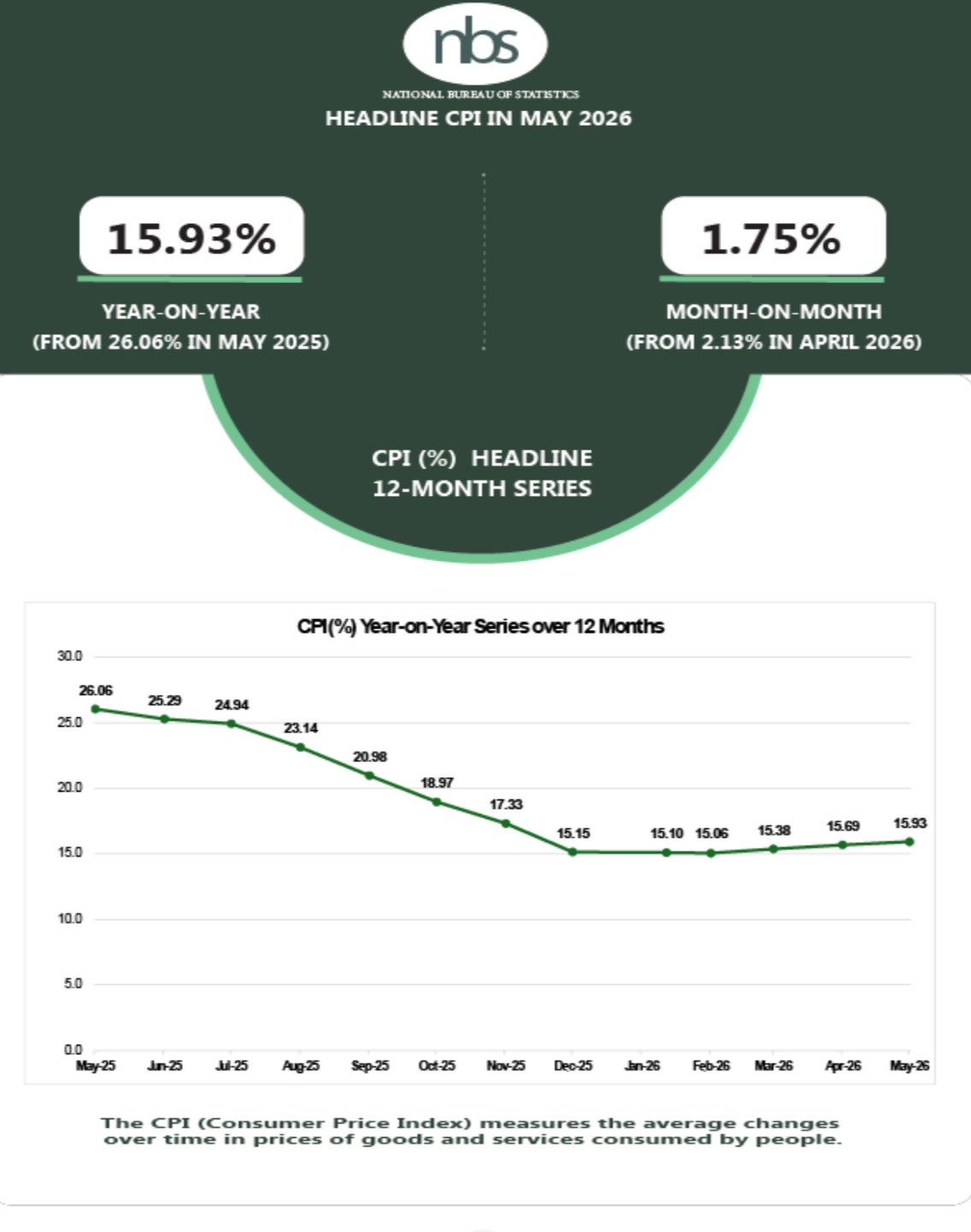
The National Bureau of Statistics (NBS) says Nigeria’s headline inflation rate rose to 15.93 per cent in May.
The NBS disclosed this in its Consumer Price Index (CPI) and Inflation Report for May released in Abuja on Monday.
The report said that the May headline inflation rate showed an increase of 0.24 per cent compared to the April headline inflation rate of 15.69 per cent.
Furthermore, the report said on a month-on-month basis, the headline inflation rate in May was 1.75 per cent, which was 0.39 per cent lower than the rate recorded in April at 2.13 per cent.
“This means that in May, the rate of increase in the average price level was lower than the rate of increase in the average price level in April.”
It said on a year-on-year basis, the headline inflation rate for May 2026 stood at 15.93 per cent, compared to the 26.06 per cent recorded in May 2025.”
It listed the three major contributors to the headline inflation year- on- year as food and non-alcoholic beverages at 6.38 per cent, restaurants and accommodation services at 2.06 per cent, and transport at 1.70 per cent.
The report said that the least contributors were recreation, sports, and culture at 0.05 per cent, alcoholic beverages, tobacco, and narcotics at 0.06 per cent, and insurance and financial services at 0.07 per cent.
It said that the CPI increased to 140.7 in May 2026, and reflected a 2.4 -point increase from the 138.3 recorded in April.
The report said the food inflation rate in May 2026 was 16.96 per cent on a year-on-year basis, compared to the rate recorded in May 2025 at 24.55 per cent.
It said that on a month-on-month basis, the food inflation rate in May was 2.98 per cent, which decreased by 0.65 per cent compared to the 3.63 per cent recorded in April.
The NBS highlighted the rate of change in the average prices of fresh onions, maize(corn), grains, melon(egusi), water yam, cassava flour, crayfish and fresh pepper.
“Others are fresh tomatoes, wheat grain, cassava tuber, yam,tuber, sweet potatoes, fresh ginger, plantain, cowpea, among others.”
The report said “All items less farm produces and energy” or core inflation, which excludes the prices of volatile agricultural produce and energy, stood at 16.82 per cent in May. on a year-on-year basis.
“This shows a decline of 8.1 per cent when compared to the 24.92 per cent recorded in May 2025.
“On a month-on-month basis, the core inflation rate was 1.94 per cent in May which increased by 0.92 per cent compared to the 1.03 per cent recorded in April.”
The report said that the inflation rate of the sub-indices for May 2026 on a month-on-month basis showed that energy stood at 0.72 per cent compared to 8.0 per cent in April.
It said farm produce stood at 0.86 per cent compared to 6.0 per cent in April, while services stood at 2.48 per cent compared to the 2.1 per cent recorded in April.
Goods stood at 0.73 per cent compared to the 3.2 per cent recorded in April, while imported food stood at 2.28 per cent compared to the 4.4 per cent recorded in April.
It said that on a year-on-year basis in May 2026, the urban inflation rate was 16.07 per cent.
“On a month-on-month basis, the urban inflation rate was 1.99 per cent, which increased by 0.13 per cent compared to April at 1.86 per cent.”
The report said that in May, rural inflation rate was 15.60 per cent on a year-on-year basis.
“On a month-on-month basis, the rural inflation rate was 1.17 per cent, which decreased by 1.63 per cent compared to April at 2.80 per cent.”
On states’ profile analysis, the report showed that in May, the all-items index inflation rate on a year-on-year basis was highest in Yobe at 24.94 per cent, followed by Anambra at 23.29 and Sokoto at 22.60 per cent.
It said that the lowest rise in headline inflation on a year-on-year basis was recorded in Niger at 3.07 per cent, followed by Plateau at 7.10 per cent and Edo at 7.73 per cent.
However, the report said that in May, the inflation rate on a month-on-month basis was highest in Benue at 8.23 per cent, followed by Bayelsa at 7.62 per cent and Borno at 7.29 per cent.
“Niger at -4.55 per cent, followed by Zamfara at -3.36 per cent and Taraba at -2.67 per cent recorded a decline in month-on-month inflation.”
The report said that on a year-on-year basis, food inflation was highest in Adamawa at 29.62 per cent, followed by Kwara at 28.47 per cent, and Rivers at 28.40 per cent.
“Borno at -6.53 per cent, followed by Taraba at 1.13 per cent and Bayelsa at 5.99 per cent recorded the slowest rise in food inflation on a year-on-year basis.’’
It said that on a month-on-month basis, food inflation was highest in Bauchi at 7.73 per cent, followed by Ogun at 6.86 per cent, and Jigawa at 6.69 per cent.
“Niger at -3.54 per cent, followed by Katsina at -3.48 per cent and Gombe at -2.22 per cent, recorded a decline in food inflation on a month-on-month basis.”
...CPPE blames Middle East tensions for rise in May inflation, urges action on structural cost drivers
Meanwhile, in a swift response, the Centre for the Promotion of Private Enterprise (CPPE) has attributed the slight increase in Nigeria’s inflation rate in May 2026 to ongoing geopolitical tensions in the Middle East, warning that rising energy costs and supply chain disruptions continue to exert pressure on domestic prices.
In a policy brief on the May 2026 inflation report, the Chief Executive Officer of CPPE, Dr. Muda Yusuf, said headline inflation rose marginally by 0.24 percentage points from 15.69 per cent in April to 15.93 per cent in May, reflecting the impact of global market uncertainties.
According to him, the escalation of tensions in the Middle East triggered higher crude oil prices, increased marine insurance premiums, disruptions to international shipping routes and elevated import costs, all of which contributed to inflationary pressures in Nigeria.
Despite the uptick, he noted that there were encouraging signs beneath the headline figures. Month-on-month inflation eased from 2.13 per cent in April to 1.75 per cent in May, while food inflation moderated from 3.63 per cent to 2.98 per cent during the same period.
The organisation said the slower pace of price increases suggests that inflationary pressures, although persistent, may be gradually easing.
CPPE also highlighted the significant progress made over the past year, noting that the current inflation rate remains far below the 26.06 per cent recorded in May 2025.
The policy brief identified food and beverages, transportation, housing, energy, health and education as the major contributors to inflation, accounting for about 87 per cent of the headline rate.
Dr. Yusuf expressed concern over food inflation, which stood at 16.96 per cent, surpassing the overall inflation rate and continuing to erode household purchasing power.
He pointed to insecurity in major agricultural zones as a key structural factor driving food prices higher.
According to him, attacks on farming communities have displaced farmers, reduced cultivated land, disrupted supply chains and increased transportation costs, resulting in lower agricultural output and tighter food supplies.
“Addressing insecurity is not only a security imperative but also a critical inflation-management strategy,” the report stated.
CPPE maintained that Nigeria’s inflation challenge remains largely cost-push in nature and cannot be effectively resolved through monetary tightening alone.
Instead, it urged government authorities to focus on tackling the structural causes of high production and distribution costs through improved food security, enhanced logistics infrastructure, investments in mass transit and rail transportation, stronger energy security and the restoration of safety in farming communities.
Looking ahead, the organisation expressed cautious optimism about the inflation outlook, citing recent diplomatic breakthroughs in the Middle East and the moderation of crude oil prices from around $90 per barrel to approximately $83 per barrel.
CPPE said that if geopolitical tensions continue to ease and global supply chain conditions improve, inflationary pressures could begin to moderate from the third quarter of 2026.
The group concluded that the recent inflation increase reflects external shocks and domestic structural challenges rather than underlying macroeconomic instability, stressing that policy efforts should concentrate on addressing insecurity, food supply constraints, transportation costs and energy prices to improve citizens’ welfare and business competitiveness.
READ ALSO:MAN urges FG, NESREA to suspend proposed ban on single-use plastics