
By David Oluwatosin
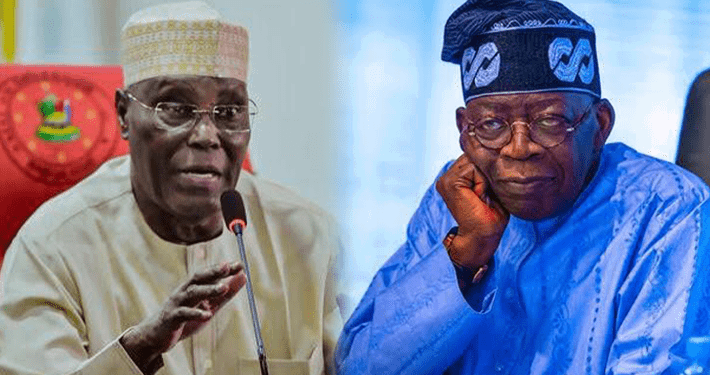
Former Vice-President and presidential candidate of the African Democratic Congress (ADC), Atiku Abubakar, has challenged President Bola Ahmed Tinubu’s declaration that Nigeria has entered an “age of prosperity”, arguing that economic growth figures have yet to translate into meaningful relief for millions of Nigerians.
Atiku, in his Independence Day address on Thursday, criticised the Tinubu administration’s handling of the economy, saying Nigerians were still grappling with high food, fuel, transportation, healthcare and education costs despite the government’s claims of improved economic performance.
His comments came hours after President Tinubu, in his address to mark Nigeria’s 66th Independence Anniversary, said the country had moved beyond the most difficult phase of its economic reforms and was entering a period of “shared and widespread prosperity.”
Tinubu said Nigeria’s economy had grown by more than four per cent in 2026, with both the oil and non-oil sectors contributing to what he described as renewed stable growth.
He also cited falling inflation, improved foreign exchange stability, rebuilt foreign reserves and stronger non-oil exports as evidence of economic progress.
However, Atiku questioned the extent to which those macroeconomic improvements were being felt by ordinary Nigerians.
“Bola, where is this prosperity?” Atiku asked, arguing that slower inflation does not reverse the loss in purchasing power suffered by households as prices continue to rise.
He said economic growth should ultimately be measured by the ability of Nigerians to afford food, transportation, healthcare, education and other basic necessities.
Atiku faulted what he described as the government’s reliance on economic growth statistics to demonstrate success, saying businesses and citizens were still facing significant pressures.
“Growth must improve lives. It cannot be a certificate of success that government awards itself while citizens struggle to survive,” he said.
The ADC candidate also criticised the removal of fuel subsidy and other reforms implemented by the Tinubu administration, arguing that their immediate effect had been to increase the cost burden on households and businesses.
He questioned when the savings from subsidy removal would translate into tangible benefits for Nigerians, particularly through lower transportation and energy costs.
Atiku proposed what he described as a capped and budgeted production subsidy for petrol refined in Nigeria, including fuel produced by modular refineries.
Under the proposal, imported petrol would not qualify for the subsidy, while payments would be independently audited and the savings from reduced government waste used to support the programme.
“The principle is simple: produce here, refine here, create jobs here and pay less here,” he said.
The former Vice-President also linked Nigeria’s economic challenges to insecurity, saying farmers, businesses and families could not benefit fully from economic opportunities where insecurity continued to disrupt production and livelihoods.
He argued that farmers needed safe access to their fields, while manufacturers were being confronted by high electricity costs, insecurity and other production challenges.
Atiku further questioned the effectiveness of government loan programmes, saying access to credit should not be presented as a substitute for decent-paying jobs and affordable public services.
He called on the government to provide details of beneficiaries of its intervention programmes and demonstrate what previous borrowing had delivered.
The ADC candidate also criticised the government’s budget management, particularly the continued implementation of the 2025 budget into 2026 alongside the 2026 budget.
He argued that Nigerians deserved clearer information on what had been funded, which projects had been completed and what government obligations remained outstanding.
“A budget should be a timetable for delivery, not a ball passed from one year to the next,” Atiku said.
He also challenged the administration’s claim that its reforms had a “human face”, saying Nigerians were still confronted with expensive food, healthcare, school fees, electricity bills and transportation.
Atiku also challenged Tinubu over the President’s promise that transport fares would be reduced from October 1.
He demanded that the government publish the routes covered by the reduction, the old and new fares and the number of Nigerians benefiting from the policy.
“Today is October 1, and commuters are still asking where they can find the lower fares. Show them the routes and the prices. Nigerians cannot board an announcement,” he said.
READ ALSO:PETROAN urges FG to restart state refineries by January
The issue was part of a broader disagreement between the two politicians over how the government’s economic reforms should be assessed. Tinubu had said lowering the cost of living was now a central priority of his administration, with emphasis on reducing the cost of producing and transporting goods.
Looking ahead to the 2027 election, Atiku said an ADC administration would focus on making food, fuel and electricity more affordable, while improving access to healthcare and education, strengthening security and increasing transparency in public spending.
He said government performance should be assessed by improvements in the living conditions and safety of Nigerians rather than economic statistics alone.
Atiku also called for greater accountability in public spending and urged the government to explain how its policies had affected households and businesses.
He maintained that Nigerians should be able to question their leaders, organise peacefully and demand political change within the framework of the law.
The former Vice-President concluded by calling for a change of government in 2027, saying Nigerians should use their votes to determine the country’s political direction.
His criticism adds to the political debate over the Tinubu administration’s economic reforms, with the President pointing to improving macroeconomic indicators while opposition figures continue to focus on the effects of high living costs on households.

