By Seun Ibiyemi
Nigeria is seeking to rebuild its economic relationship with India and restore bilateral trade to its previous peak of nearly $15 billion, while pushing for greater Indian investment in sectors beyond crude oil.
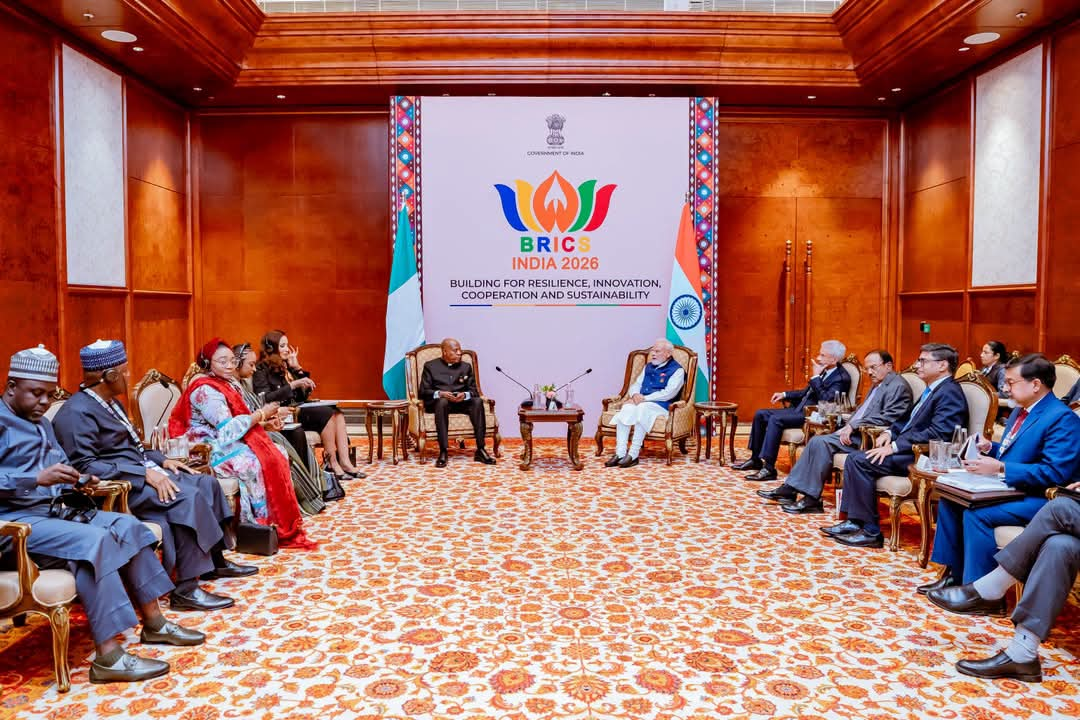
The development followed a bilateral meeting between Vice President Kashim Shettima and Indian Prime Minister Narendra Modi on the sidelines of the just-concluded BRICS Leaders’ Summit in New Delhi.
Bilateral trade between Nigeria and India reached about $14.95 billion in 2021–2022, but declined sharply after a reduction in Indian purchases of Nigerian crude oil.
Figures disclosed by the Indian High Commissioner to Nigeria, Abhishek Singh, showed that bilateral trade fell to $7.13 billion in 2024–2025, before recovering to about $9 billion in 2025–2026.
Modi called for renewed purchases of Nigerian crude, saying stronger energy trade could help lift bilateral commercial exchanges back towards previous levels.
Shettima said Nigeria would consider the request as part of President Bola Ahmed Tinubu’s efforts to attract investment and establish strategic partnerships capable of expanding the country’s productive capacity.
While acknowledging the importance of crude oil to the bilateral relationship, Shettima said Nigeria wanted a broader economic partnership with India that would support domestic production, job creation and value addition.
He identified pharmaceuticals, defence, digital technology and the creative industries as areas where Nigeria is particularly interested in attracting Indian partnerships.
The Vice President stressed that such partnerships should create employment, facilitate skills and technology transfer and provide opportunities for Nigeria’s growing youth population.
“The Tinubu administration is particularly interested in moving Nigeria’s relationship with India beyond the traditional exchange of commodities towards investments that support domestic production and value addition,” Shettima said.
The two sides also discussed opportunities for cooperation in renewable and clean energy, power, healthcare, capacity building, financial technology and other emerging sectors.
Nigeria and India also agreed to deepen cooperation in fintech and digital technology, building on previous agreements concerning digital public infrastructure.
Shettima said the Federal Government wanted international partnerships to translate into actual investments, technology transfer, industrial growth and tangible economic benefits for Nigerians.
Both leaders also emphasised the importance of stronger private-sector participation, particularly in sectors where Indian companies have significant expertise and Nigeria has strong market demand.
Modi, meanwhile, appreciated Nigeria’s hospitality towards the sizeable Indian community living and doing business in the country.
Minister of Women Affairs, Imaan Sulaiman-Ibrahim, said Nigeria was adopting lessons from India’s women-led self-help group model to strengthen financial inclusion and grassroots enterprise.
READ ALSO : Nigeria eyes global gas hub status as NNPC targets 600Tcf reserves
She said the approach was being implemented through the Nigeria for Women Programme Scale-Up, with Women Affinity Groups connecting women to finance, skills and markets.
According to the minister, the initiative is part of the Federal Government’s broader efforts to increase women’s participation in productive economic activities while strengthening social protection and interventions against sexual and gender-based violence.
“Women’s economic empowerment is fundamental to our ambition of building a $1 trillion economy. We must deliberately bring millions more Nigerian women into productive economic activity,” she said.
Nigeria and India reaffirmed their commitment to sustaining high-level political and economic engagement through the India-Africa partnership framework and other multilateral platforms.