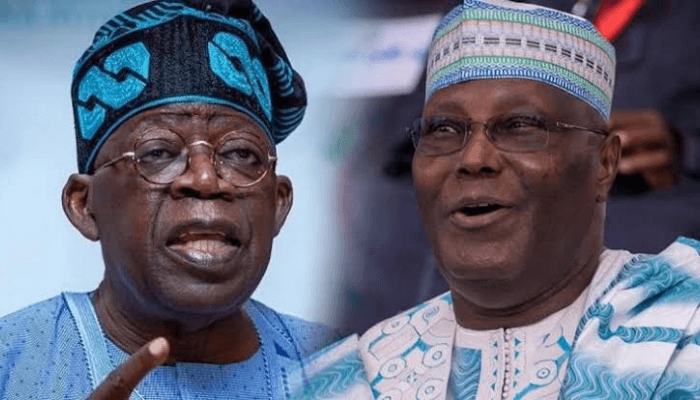
Former Vice President and African Democratic Congress presidential candidate, Atiku Abubakar, has challenged the Federal Government to investigate and prosecute him if it has evidence linking him to alleged financial impropriety in Nigeria’s power sector.
Atiku’s challenge came amid a renewed political dispute over the alleged $16bn spent on power projects during the administration of former President Olusegun Obasanjo, in which Atiku served as Vice President.
In a statement issued on Wednesday by his Senior Special Assistant on Public Communication, Phrank Shaibu, Atiku accused the President Bola Tinubu-led administration of resurrecting old allegations to divert public attention from questions surrounding the utilisation of revenues generated after the removal of petrol subsidy.
He said successive governments had had nearly two decades to investigate the allegations but none had produced evidence sufficient to prosecute him.
“The National Assembly investigated the power projects. I was never invited to answer any allegation of wrongdoing.
“Yes, I chaired the National Council on Privatisation as Vice President. But on the power project, I disagreed with its concept and did not preside over its implementation. The responsible minister did,” Atiku said.
He added that he had repeatedly invited authorities to investigate him, insisting that allegations without prosecution could not be used as a substitute for evidence.
“It is still not too late. Investigate me. Invite me. Produce the evidence. Prosecute me if you have a case. But propaganda cannot substitute for evidence,” he said.
Atiku shifts focus to subsidy proceeds
The ADC candidate argued that the renewed attention on the old power-sector controversy was politically motivated, alleging that the government was seeking to avoid answering questions about what had happened to the additional revenues generated since petrol subsidy was abolished in 2023.
READ ALSO:Tinubu tasks NLNG to end gas flaring, boost domestic utilisation
Atiku said Nigerians had accepted the economic pain associated with subsidy removal on the promise that the savings would be redirected towards development.
He, however, argued that Nigerians were yet to see sufficient benefits from the policy.
“Today, petrol is more expensive, transportation is more expensive, food is more expensive, and the purchasing power of the Nigerian worker has been devastated,” he said.
He questioned why government revenues had increased while various fiscal incentives, waivers, tax credits and concessions remained available to major economic interests.
“So, our question remains brutally simple: where is the people’s money?” he asked.
Atiku maintained that government could not withdraw relief from ordinary Nigerians on the grounds that subsidies were fiscally unsustainable while continuing to provide incentives to powerful businesses.
The Presidency, however, dismissed Atiku’s arguments and accused him of repeatedly changing his position on petrol subsidy.
Special Adviser to the President on Information and Strategy, Bayo Onanuga, made the criticism in a statement titled, “Atiku confused on petrol subsidy; third U-turn in one week shows he is simply playing politics.”
Onanuga said Atiku and his aides had offered different explanations of the proposed subsidy within a short period, creating uncertainty over the policy.
He challenged the former Vice President to explain exactly how his proposed “targeted subsidy” would operate, including its cost, beneficiaries, funding source and conditions for termination.
“We therefore urge Atiku to stop shifting positions and explain precisely what he means by ‘targeted subsidy’: how much will it cost, who will benefit, how will beneficiaries be identified, how will it be funded and what objective economic conditions will determine its eventual termination?” Onanuga asked.
The presidential aide also faulted Atiku’s proposal to link the intervention to discounted crude oil supplied to domestic refineries.
According to Onanuga, crude oil refining produces several products beyond petrol, including diesel, aviation fuel, kerosene, lubricants, asphalt and petrochemical feedstocks.
He therefore questioned whether the proposed intervention would cover those products as well.
Onanuga further recalled that diesel was deregulated in 2004 under the administration in which Atiku served as Vice President, while kerosene and aviation fuel were deregulated at different times.
He argued that reducing petrol prices alone would not address all the factors responsible for Nigeria’s high cost of living, citing insecurity, exchange rates, logistics, storage challenges, flooding and agricultural input costs.
The controversy over the power-sector expenditure dates back to the period after Obasanjo left office in 2007.
The House of Representatives and the Yar’Adua administration subsequently examined spending and commitments on power projects, with figures cited publicly at different times, including the widely referenced $16bn.
Atiku has consistently denied wrongdoing and maintained that he was not responsible for implementing the projects.
The latest exchange has now linked the long-running power-sector controversy with the broader political battle over petrol subsidy, economic reforms and public accountability ahead of the 2027 presidential election.
While Atiku is demanding evidence and prosecution if wrongdoing can be established, the Presidency is questioning the credibility and economic viability of his proposed subsidy policy.