
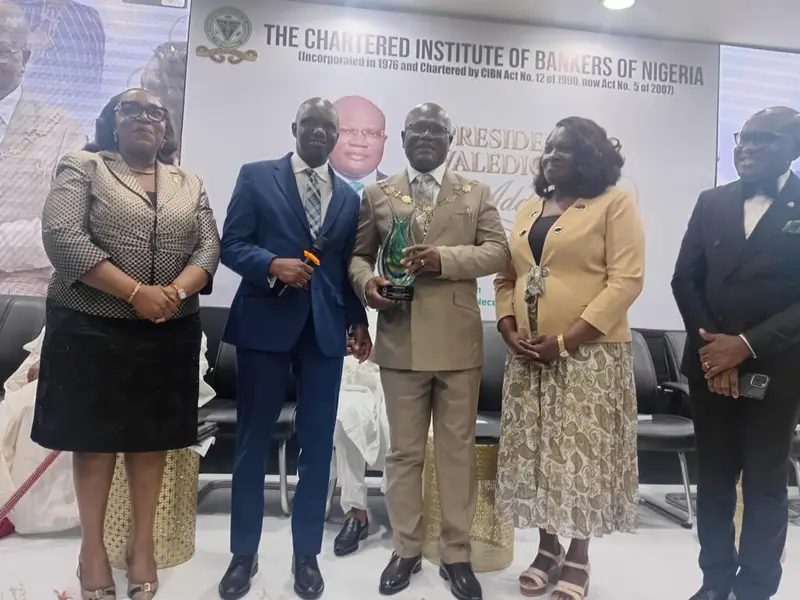
Outgoing President of the Chartered Institute of Bankers of Nigeria (CIBN), Prof. Pius Olanrewaju, has called for stronger ethics and professionalism to sustain stability and public confidence in Nigeria’s financial system.
Olanrewaju made the call on Thursday in Lagos during his valedictory address marking the end of his tenure as president of the institute.
Speaking on the importance of ethics and professionalism in banking, he said academic qualifications alone could not sustain institutions lacking integrity, accountability and responsible leadership.
He referenced the 2009 banking crisis, when about N1.1 trillion in non-performing loans weakened 10 Nigerian banks, noting that the crisis reflected deeper institutional failures.
“The issue was not qualifications. What failed was character, institutional culture and structures that should uphold integrity,” he said.
According to him, compliance with regulations should never be mistaken for genuine ethical conduct.
“Compliance tells you what you must do to avoid sanctions, but ethics defines who you are,” he added.
Olanrewaju stated that banking, as a trust-based profession, required honesty, transparency and accountability from operators, regulators and supervisors.
He warned that insider abuse, earnings manipulation, consumer exploitation and cyber fraud continued to threaten the integrity of the financial sector.
The outgoing CIBN president also noted that digital banking and financial technology had introduced new ethical risks, including privacy breaches, algorithmic bias and cybercrime.
According to him, professionalism represents a public commitment to standards that go beyond legal and contractual obligations.
“A profession is a community of accountability, where members uphold codes, peer review and responsibility,” he said.
He stressed that ethics and professionalism were mutually reinforcing and essential for sustainable financial system stability.
Olanrewaju further argued that capital requirements and compliance frameworks alone could not guarantee resilience without morally grounded professionals.
He urged regulators, including the Central Bank of Nigeria, to pay closer attention to organisational culture and incentive structures within financial institutions.
He also advised bank executives to prioritise long-term performance over short-term profit targets.
Addressing young banking professionals, he described integrity as their most valuable asset.
“It takes years to build a reputation and minutes to destroy it,” he said.
Reflecting on his tenure, Olanrewaju expressed appreciation to past presidents, council members and stakeholders for their support.
He said the institute recorded improvements in membership growth, operational efficiency, ethics enforcement, capacity development and institutional rebranding during his administration.
READ ALSO:PenCom grants PFAs special approval to invest in Dangote refinery IPO
According to him, induction and professional development programmes also expanded, attracting participants from across Africa.
He further advocated stronger disciplinary processes and the publication of misconduct cases to reinforce accountability in the profession.
Olanrewaju maintained that trustworthiness remained critical to economic development, noting that bankers play a central role in building an inclusive financial system.
He congratulated the institute’s new leadership and urged them to sustain the organisation’s legacy across Nigeria and the African continent.