By Seun Ibiyemi
The International Monetary Fund (IMF) has revised Nigeria’s economic growth forecast for 2026 downward by 0.3 percentage points, lowering it from 4.4 per cent to 4.1 per cent, citing mounting global uncertainties and domestic economic pressures.
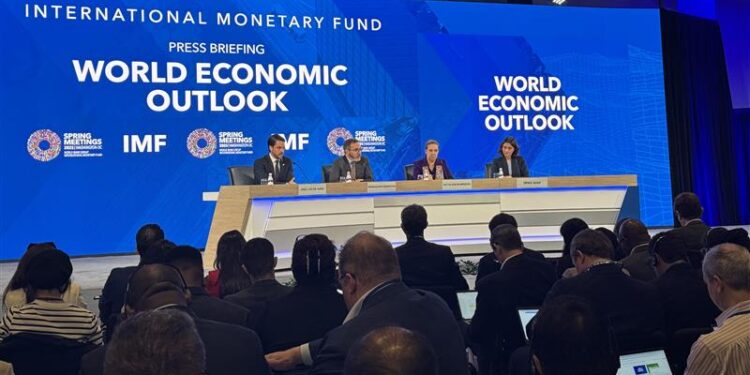
The revised outlook was disclosed during a media briefing for the launch of the IMF’s April 2026 Global Financial Stability Report.
According to the Fund, the downgrade reflects a combination of factors, including rising costs, weakening global demand, and disruptions linked to ongoing geopolitical tensions affecting commodity markets.
Speaking at the briefing, Deniz Igan explained that while Sub-Saharan Africa experienced relatively strong growth in 2025, recent global shocks have dampened the region’s economic momentum.
She noted that the ongoing war has softened non-oil commodity prices and worsened terms of trade for oil-importing countries, adding that declining foreign aid is also placing additional strain on economies across the region.
“Turning to Nigeria, we have revised growth down by 0.3 percentage points to 4.1 per cent in 2026,” Igan said, adding that higher fuel, fertilizer, and shipping costs are expected to weigh on non-oil sector activity, even as higher oil prices provide partial support.
The IMF also highlighted inflationary pressures in Nigeria, where inflation stood at about 15.06 per cent year-on-year as of February 2026, while the central bank maintained a benchmark interest rate of 26.50 per cent in efforts to stabilise prices.
The Fund emphasized the need for continued tight monetary policy and careful management of inflation expectations and exchange rate stability.
Read Also:Shettima leads delegation to Kebbi, assures families of slain officers of support
Globally, the IMF projected a slowdown in economic growth, with world output expected to ease from 3.4 per cent in 2025 to 3.1 per cent in 2026, before a modest recovery in 2027.
Advanced economies are also expected to slow, while emerging markets show mixed performance. India is projected to remain one of the fastest-growing major economies at 6.5 per cent, while South Africa is forecast to grow at just 1.0 per cent in 2026.
For Sub-Saharan Africa, growth is expected to dip slightly from 4.5 per cent in 2025 to 4.3 per cent in 2026, before improving marginally the following year, reflecting persistent global headwinds and domestic structural challenges.