By Seun Ibiyemi
The Federal Government has unveiled a major reconstruction and economic recovery initiative in the North-East, featuring the deployment of 10,330 electric vehicles, plans for a 50-megawatt solar power project and the approval of a ₦30 billion Youth and Women Empowerment Fund.
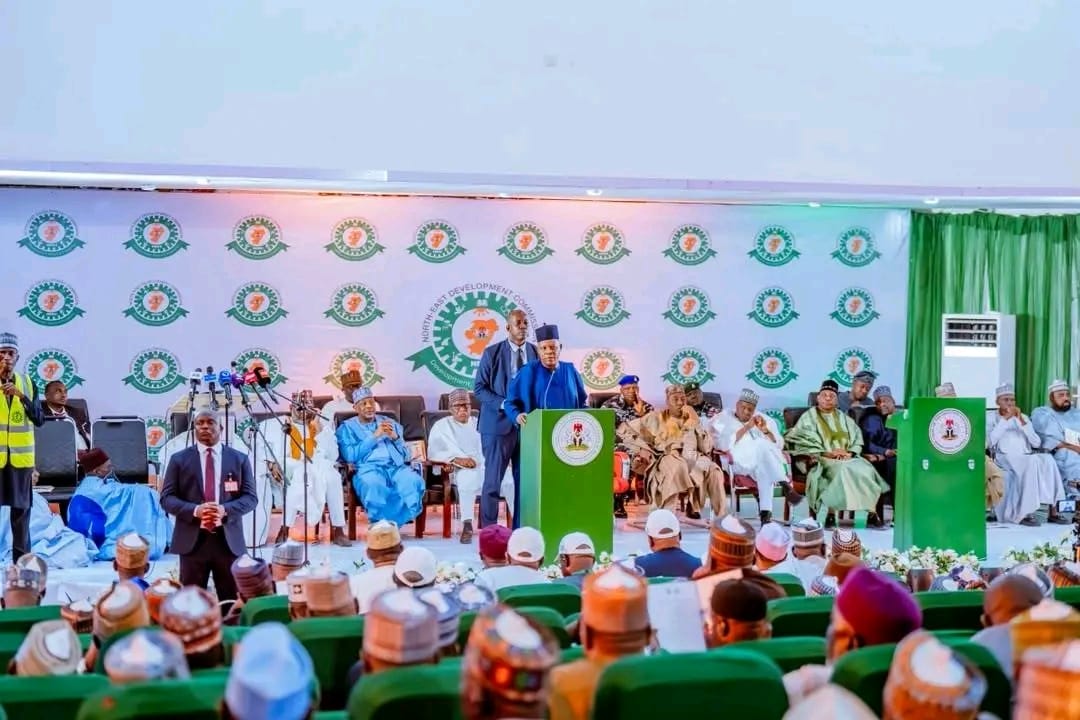
The initiatives, announced by Vice President Kashim Shettima in Maiduguri, Borno State, are aimed at rebuilding communities affected by years of insurgency, restoring livelihoods, expanding economic opportunities and accelerating development across the region.
Shettima announced the interventions on Tuesday during the presidential launch and commissioning of multi-sectoral development projects executed by the North-East Development Commission (NEDC).
He said the ₦30 billion empowerment fund, being established in partnership with the Bank of Industry (BOI), would provide financing for micro, small and medium enterprises (MSMEs), particularly businesses owned by young people and women.
The Vice President said the administration of President Bola Ahmed Tinubu remained committed to translating its promise to rebuild the North-East into practical interventions capable of improving living conditions and stimulating economic growth.
He noted that years of insecurity and hardship had not weakened the region’s determination to recover and rebuild.
“We have long maintained, as a region, that our right to tomorrow cannot be confiscated by the violence of today or yesterday. For years, the North-East has carried the cost of insecurity and hardship without losing sight of our redemption,” he said.
According to Shettima, the deployment of 10,330 electric vehicles, comprising metro buses, taxis and tricycles, alongside supporting facilities, would promote clean energy, reduce transportation costs and improve mobility across the region.
He explained that the investment would also modernise public transportation, support economic activities and reduce environmental pollution.
“This investment will not only promote clean energy, lower transport costs and modernise public service delivery and mobility but also support economic growth while protecting our environment,” he stated.
The Vice President also announced plans to deploy 50 megawatts of solar-powered mini-grids across the North-East to improve electricity supply, support businesses and strengthen healthcare delivery.
On road infrastructure, he disclosed that the NEDC had constructed and rehabilitated 51 roads and 35 bridges, while work continued on other projects across the region.
He added that more than 100,000 solar streetlights had been installed under the Light Up the North-East initiative to improve security, public lighting and economic activities.
“Our people must be able to move freely between communities, take their produce to market and seek opportunities beyond their villages,” Shettima said.
In the education sector, he said the Commission had constructed 18 mega schools, 232 classrooms and 22 hostels, alongside interventions in 49 tertiary institutions.
READ ALSO:Oyetola woos Polish investors to Nigeria’s fisheries, aquaculture sectors
Scholarships and bursaries had also been provided to deserving students, including orphans and vulnerable children in secondary schools.
“Our ticket to the future is sound and accessible education,” he added.
In healthcare, Shettima disclosed that the NEDC had executed 92 projects across hospitals and specialist facilities, while providing eight MRI and CT scanning units, other medical equipment and medicines to tertiary healthcare institutions.
The Commission had also constructed more than 3,500 houses under its mass housing programme to support displaced persons and vulnerable households.
Other interventions include more than 100 water, sanitation and hygiene facilities and over 1,100 solar-powered boreholes and community water supply schemes.
“For those driven from their homes, recovery must begin with a place to call their own,” the Vice President stated.
Shettima further disclosed that farmers across the region had received more than 2,000 units of agricultural machinery and equipment, alongside over 38,000 bags of fertiliser to improve food production.
He said the Federal Government’s support for women-owned businesses, MSMEs, skills development, vocational training and youth empowerment was driven by the need to create sustainable livelihood opportunities for households.
Meanwhile, during a separate Borno State MSME Clinics and Artisans Beneficiary Town Hall, the Vice President reaffirmed the Federal Government’s commitment to supporting small businesses, describing them as the backbone of the Nigerian economy.
The engagement focused on assessing the progress of businesses that had benefited from government intervention programmes.
Special Adviser to the President on Job Creation and MSMEs, Temitola Adekunle-Johnson, disclosed that 5,000 small business owners in Borno State had benefited from various Federal Government support programmes.
Borno State Governor, Professor Babagana Umara Zulum, said economic empowerment went beyond poverty alleviation, reaffirming his administration’s commitment to supporting small businesses as part of its reconstruction agenda.
Similarly, Minister of State for Industry, Senator John Owan Enoh, commended the resilience and ingenuity of MSMEs in creating jobs and contributing to national economic development.
He reiterated the Tinubu administration’s commitment to empowering entrepreneurs and expanding opportunities for small businesses.
Managing Director and Chief Executive Officer of the NEDC, Mohammed Goni Alkali, said the electric mobility initiative would provide affordable transportation, reduce dependence on conventional fuels and stimulate economic activities.
He also disclosed that the Commission had introduced a ₦25 billion scholarship scheme for students, particularly children from disadvantaged families, alongside intervention funds for MSMEs.
Alkali said the Commission had rehabilitated and reconstructed more than 50 roads across the region and provided shelter, food and other forms of social and economic support to vulnerable communities.
He assured stakeholders that the Commission would maintain accountability in the implementation of its projects.
“Every naira we spend will be accounted for,” he said.
Earlier, Chairman of the Northern Governors’ Forum and Gombe State Governor, Muhammadu Inuwa Yahaya, reaffirmed the commitment of governments at all levels to improving citizens’ welfare.
He commended the NEDC for its electric mobility initiative, describing it as a timely intervention that would provide affordable transportation.
Yahaya also disclosed that northern governors were considering additional interventions, including the North-East shuttle and rail network, while calling for stronger collaboration among state governments, local councils and the Commission.
Borno State Governor and Chairman of the North-East Governors’ Forum, Professor Babagana Umara Zulum, described the projects as a significant milestone in the region’s reconstruction following years of insurgency.
He said the electric mobility programme would reduce transportation costs, create employment and improve livelihoods.
Zulum pledged the continued institutional support of the six North-East governors towards building a peaceful, prosperous and sustainable region.
Minister of Regional Development, Abubakar Momoh, said the electric mobility project would improve citizens’ living conditions, recalling that Shettima had urged the NEDC in 2023 to invest in smart transportation.
He, however, called for proper maintenance of the electric vehicles and urged project managers to involve local communities in vehicle repairs and the operation of charging facilities to create additional employment opportunities.
The Vice President also commissioned the Fatirin-Galtimari Bridge constructed by the NEDC and inspected the electric vehicle charging station and the Commission’s new headquarters complex, both under construction.
Chairman of the NEDC Governing Board, Major General Paul Tarfa (rtd.), commended security personnel for their contributions to restoring peace in the region and urged beneficiary communities to protect the projects.
Similarly, Executive Chairman of the Presidential Initiative on Compressed Natural Gas (Pi-CNG), Ismaeel Ahmed, described the electric mobility programme as consistent with the Federal Government’s transportation and energy reforms.
He said electric vehicles would help reduce transportation costs for citizens, while commending the Vice President and the six North-East governors for their commitment to regional development.
The interventions form part of the Federal Government’s broader reconstruction and recovery efforts aimed at restoring infrastructure, expanding economic opportunities and improving the livelihoods of communities affected by insecurity in the North-East.