…Commissions REA’s 3MW solar hybrid project at Michael Okpara University
By Seun Ibiyemi
The Federal Government has unveiled plans to combine improvements to the national electricity grid with renewable and distributed energy systems as part of efforts to address Nigeria’s persistent power supply challenges and expand electricity access across the country.
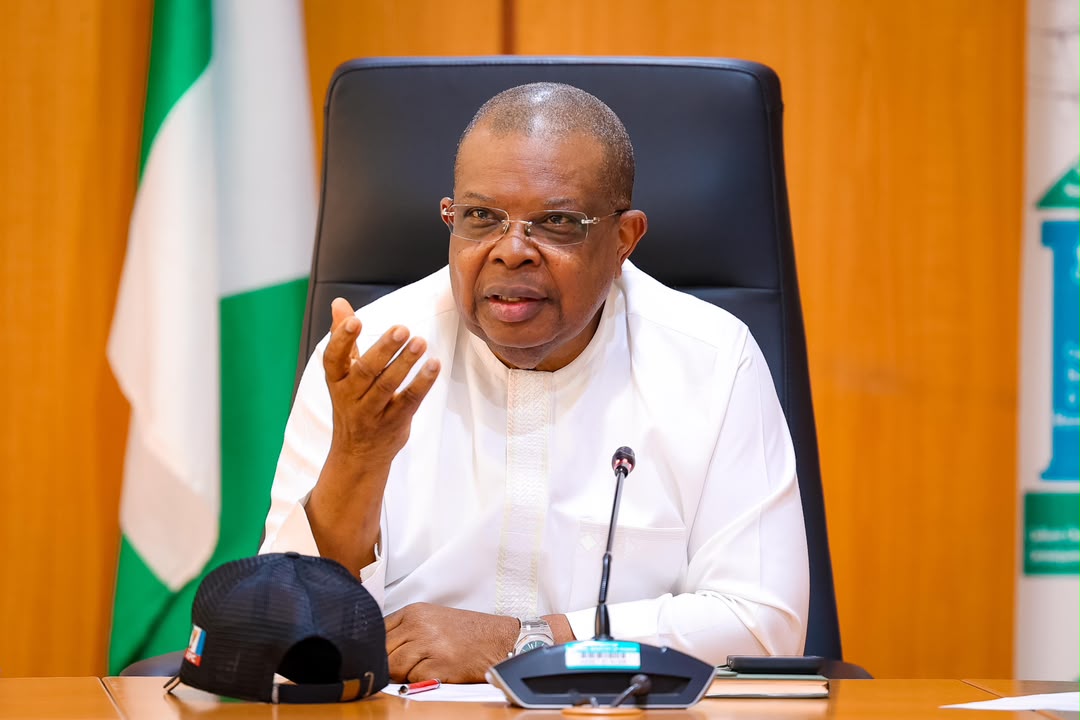
The Minister of Power, Joseph Tegbe, disclosed this at the commissioning of a 3.0-megawatt (MW) solar hybrid power project at Michael Okpara University of Agriculture, Umudike, Abia State.
The project, implemented under the Federal Government’s Energising Education Programme (EEP) Phase II by the Rural Electrification Agency (REA), is designed to provide reliable electricity for academic activities, research and other operations at the institution.
The programme, supported by the World Bank, covers seven Nigerian universities and two teaching hospitals across the country’s six geopolitical zones.
Speaking at the commissioning ceremony, Tegbe said the government’s electricity strategy recognised the need to strengthen existing grid infrastructure while deploying renewable energy solutions tailored to the needs of communities and critical institutions.
He said President Bola Tinubu’s administration was committed to transforming electricity from a persistent constraint on economic growth into a dependable driver of national prosperity.
According to him, the President places significant importance on education and is determined to ensure that young Nigerians have access to an enabling environment to learn, acquire skills and fulfil their potential.
READ ALSO:FG flags off ₦1.45trn Lagos ports modernisation
“The Federal Government’s approach combines stronger grid infrastructure with renewable and distributed energy systems suited to different communities and institutions.
“Universities, healthcare facilities, and productive centres require solutions that respond to their actual needs,” Tegbe said.
The Abia State Governor, represented by the Commissioner for Power, Ikechukwu Monday, described the Energising Education Programme as an excellent initiative with significant relevance to the country’s educational and economic development.
He commended the Federal Government for its commitment to expanding electricity infrastructure across Abia State and other parts of the country.
According to him, the project would benefit lecturers, students and researchers, particularly those involved in scientific research and innovation.
He added that the intervention demonstrated the Federal Government’s determination to support the institution’s energy requirements and address longstanding electricity inadequacies.
Also speaking, the Managing Director of the Rural Electrification Agency, Dr Abba Aliyu, disclosed that the commissioned facility comprised a 3MW solar hybrid power plant, supported by 2.2 megawatt-hours (MWh) of battery energy storage.
He said the project also included rehabilitated electricity distribution infrastructure, streetlights and a renewable energy training centre.
Aliyu explained that the facility went beyond providing electricity, as it would create opportunities for uninterrupted research, agricultural innovation, extended learning hours and entrepreneurship development.
He stressed that reliable electricity was critical to transforming Nigeria’s agricultural sector, noting that countries leading global agricultural production had successfully integrated energy, technology, research and innovation into their farming systems.
“Globally, the countries that dominate agricultural production are not necessarily those with the largest agricultural land. They are those that have successfully combined agriculture with energy, technology, research, and innovation.
The REA managing director said the Federal Government, under Tinubu’s leadership and the strategic guidance of the Minister of Power, was transforming the scale, ambition and economic impact of decentralised electricity delivery.
Providing an update on the programme’s achievements, Aliyu disclosed that the Energising Education Programme had delivered electricity infrastructure across 22 federal universities and three affiliated teaching hospitals, with more than 100MW of installed generation capacity.
He said the interventions had positively impacted over 600,000 students and 50,000 academic and non-academic staff.
He added that under Phase II, supported by the World Bank, the programme had also provided practical renewable energy training to 140 female students studying science, technology, engineering and mathematics (STEM).
According to him, the initiative was part of broader efforts to improve electricity access, strengthen institutional capacity and develop local expertise in renewable energy technology.
Aliyu further disclosed that the Federal Government had delivered 198 mini-grids and facilitated the deployment of approximately 1.4 million solar home systems across the country under the completed Nigeria Electrification Project.
Building on the achievements, he said the government was implementing the $750 million World Bank-supported Distributed Access through Renewable Energy Scale-up (DARES) programme.
The initiative targets electricity access for 17.5 million Nigerians, with approximately 1,350 mini-grids expected to be deployed.
He said the government was also seeking to position Nigeria beyond being a consumer of renewable energy technologies to becoming a manufacturer and exporter of solar equipment.
“Our ambition is not just to be a consumer, but to position Nigeria as a manufacturer and exporter of solar technology.
“I envision a future where some of the renewable energy tech deployed on this project is produced in Abia State. A powered university must produce graduates and also produce solutions,” he said.
In his remarks, the Head of the Nigeria Electrification Project, Femi Akinyelure, said Nigeria was increasingly emerging as a benchmark in energy access, with efforts underway to ensure that the country’s growing technical capacity could be exported.
He noted that democratising electricity access was essential to ensuring that the benefits of economic prosperity reached all Nigerians.
Earlier, the Vice-Chancellor of Michael Okpara University of Agriculture, Prof. Ursula Ngozi Akanwa, expressed appreciation to the Federal Government for the intervention, describing reliable electricity as indispensable to the university’s academic and research responsibilities.
She said the institution’s laboratories, workshops, research facilities and practical training programmes depended on stable electricity to function effectively.
Akanwa noted that modern agricultural development increasingly relied on electricity, technology, data-driven systems and innovation to improve food production, processing, preservation and value addition.
She said the project would address a critical infrastructure gap while creating better conditions for the university to advance its academic and research objectives.
The Vice-Chancellor pledged that the university would ensure proper management of the facility and responsible utilisation of the electricity generated.