By Seun Ibiyemi
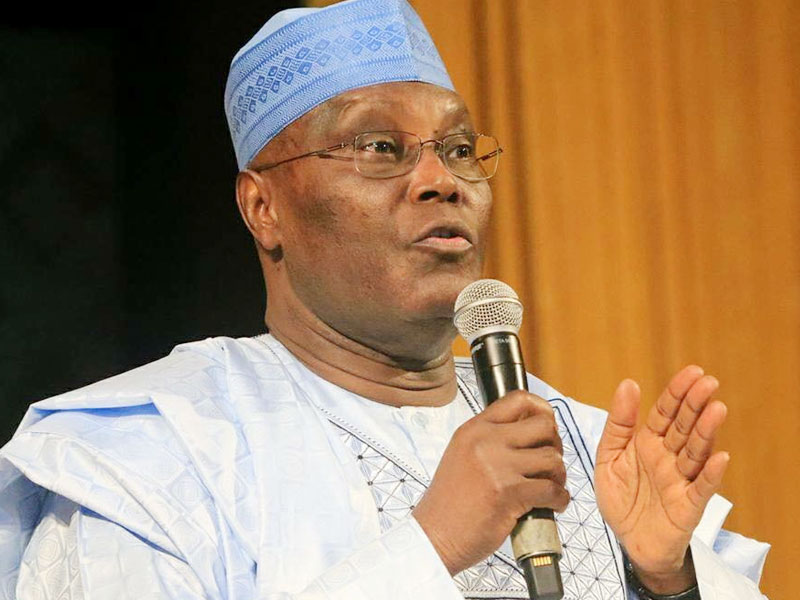
The Presidency has rejected former Vice President Atiku Abubakar’s proposed production subsidy on petrol, describing it as economically unrealistic and arguing that Nigeria lacks sufficient unencumbered crude oil volumes to sustain the policy without reviving the financial and administrative problems associated with the former fuel subsidy regime.
The Presidency said the proposal failed to account for the difference between Nigeria’s total crude oil production and the volume of crude available to the Federal Government after contractual obligations, production costs, royalties and profit-sharing arrangements with oil companies.
Special Adviser to the President on Media and Public Communications, Sunday Dare, stated this in a statement issued on Sunday titled ‘Atiku’s Demagoguery in the Face of Tinubu’s Logical Policies’.
Dare described Atiku’s recent press conference in Abuja as “a seminal example of shallow, election-laced demagoguery,” accusing the African Democratic Congress (ADC) presidential candidate of presenting an economic proposal that did not adequately consider the realities of Nigeria’s petroleum industry.
The exchange follows Atiku’s criticism of the 30-day petrol discount introduced by NNPC Retail Limited and the Federal Government’s proposed price modulation framework, which he reportedly described as a “panic-driven gimmick.”
Atiku also claimed that President Bola Tinubu had adopted elements of his economic proposals without implementing the production subsidy he considered necessary to make the policy effective.
However, the Presidency argued that a production subsidy could expose public finances to renewed pressure if the government attempted to supply crude at below-market prices without sufficient volumes to support the arrangement.
Citing comments by the Minister of Finance and Coordinating Minister of the Economy, Taiwo Oyedele, on Channels Television, Dare said Nigeria produces approximately 1.8 million barrels of crude oil daily for a population of more than 200 million people.
He argued, however, that the entire volume cannot be treated as crude freely available to the government for subsidised domestic fuel production.
According to the Presidency, decades of joint-venture agreements and production-sharing contracts mean that production costs, royalties and profit-oil arrangements reduce the volume of crude available as the government’s unencumbered equity.
Dare said the resulting volume of freely available crude was below 700,000 barrels per day.
“To propose a blanket ‘targeted production subsidy’ on crude without the physical, unencumbered volume to back it up is pure economic illiteracy,” he said.
He warned that such an arrangement could recreate the opacity, fraudulent round-tripping and fiscal losses that characterised Nigeria’s previous petrol subsidy regime.
The Presidency’s argument is that any production subsidy must be supported by verifiable crude volumes and a transparent financing framework rather than relying on Nigeria’s headline production figures.
The Presidency further argued that Nigeria’s domestic refining ambitions could not be separated from the commercial obligations governing crude oil production and supply.
Dare said refineries, including the Dangote Petroleum Refinery, require more feedstock than the government could freely provide without potentially breaching existing international supply contracts.
He cited the need for domestic refiners to source crude through imports alongside locally supplied volumes as evidence of the limitations confronting any proposal based on allocating crude below market prices.
The argument challenges the assumption that Nigeria’s crude oil production automatically translates into sufficient government-controlled supplies to finance cheaper petrol for domestic consumers.
It also highlights the competing demands on crude oil, including export commitments, contractual obligations, domestic refining requirements and government revenue.
The Presidency rejected comparisons between crude allocation and agricultural commodities such as garri and cassava, arguing that such comparisons failed to reflect the contractual and international market dynamics governing the petroleum industry.
Dare also rejected Atiku’s suggestion that the NNPC Retail discount amounted to a return of fuel subsidy.
According to him, NNPC Retail introduced the discount to mark Nigeria’s 66th Independence anniversary and subsequently offered to extend it for another 30 days.
He said the arrangement was a commercial decision through which the company absorbed short-term price pressures rather than a government-funded intervention involving payments to fuel importers.
“When NNPC Retail agrees to sell fuel at landing cost for 30 days during an unprecedented global crude price spike, it is not writing checks to opaque import cartels,” Dare stated.
He added that the company was using its corporate balance sheet to absorb temporary global market volatility, with the backing of President Tinubu.
The Presidency maintained that the arrangement was fundamentally different from the former subsidy regime, under which government resources were used to bridge the gap between the regulated pump price and the cost of supplying petrol.
It argued that the temporary discount offered consumers some relief without committing public funds to a permanent price-support programme.
The Presidency also defended the negotiated interim ceiling of N1,350 per litre on ex-gantry costs, describing it as a mechanism to cushion consumers and businesses against sudden changes in fuel prices.
Under the framework described by Dare, refiners and importers absorb short-term cost increases above the ceiling and recover the differences later when crude prices decline or exchange-rate adjustments improve their cost positions.
He said the ceiling would be reviewed monthly based on published cost audits.
Dare argued that a relatively stable petrol price would provide greater economic predictability than frequent and sharp price changes.
“N1,400 today and N1,400 tomorrow provides far greater economic stability than N1,500 today and N1,300 tomorrow,” he said.
According to him, sudden petrol price increases often trigger higher transportation fares, which may remain elevated even after fuel prices subsequently decline.
The Presidency’s position is that a temporary cost-smoothing arrangement could reduce price volatility without permanently fixing pump prices or restoring a government-funded subsidy.
However, the effectiveness of such a framework would depend on the transparency of its cost audits, the terms governing delayed cost recovery and how the arrangement affects refiners, marketers and consumers.
Beyond the petrol discount and ex-gantry ceiling, Dare outlined other measures the administration said it was pursuing to manage energy costs and ease the impact of fuel prices on households and businesses.
These include the establishment of a state-backed strategic energy reserve, the expansion of compressed natural gas (CNG) infrastructure, the naira-for-crude supply arrangement for domestic refineries and the use of windfall taxes on energy operators to support consumers.
Dare said CNG was between 60 and 70 per cent cheaper than petrol, presenting it as an alternative that could reduce transportation costs for motorists and commercial transport operators.
The Presidency also said proceeds from windfall taxes on energy operators who exploit consumers would be channelled towards transport vouchers and minimum-wage support.
It listed enforcement of the 2025 tax reform laws to dismantle illegal road levies as another measure aimed at reducing the cost of moving goods and people across the country.
The administration maintained that the measures were intended to address the effects of higher energy costs while preserving the broader economic changes introduced since 2023.
Defending the administration’s economic record, Dare said the removal of the petrol subsidy and unification of the foreign exchange market had ended what he described as a multi-trillion-naira drain on public resources.
He argued that the funds were now available to support allocations to the 36 states and local governments through the Federation Account Allocation Committee (FAAC).
The Presidency also cited the elimination of fuel queues and the narrowing of the gap between official and parallel foreign exchange rates as evidence of changes in the economy following the reforms.
READ ALSO: Tinubu hails World Bank report, says reforms stabilising economy as poverty persists
The government has consistently argued that the removal of the petrol subsidy was necessary to reduce fiscal pressures and improve the allocation of public resources.
However, the reforms have also generated public debate over their effects on petrol prices, transportation costs, inflation and household purchasing power.
Atiku’s proposal has brought those competing policy considerations back into focus, particularly the question of whether a targeted production-based intervention could offer consumer relief without recreating the weaknesses of the former subsidy system.
The latest exchange underscores the disagreement between the Presidency and the opposition over how Nigeria should balance market-based petroleum pricing, fiscal sustainability and the need to cushion citizens against rising living costs.
The statement also responded to Atiku’s reported description of Tinubu as a “dull student.”
Dare rejected the remark, contrasting the President’s accounting background with Atiku’s educational history and accusing the former vice president of using personal attacks instead of presenting a workable economic alternative.
The Presidency concluded that Nigerians should assess competing economic proposals based on their implications for long-term national economic stability rather than short-term political considerations.
The dispute is likely to keep petrol pricing and the future of subsidy policy in the national debate, particularly as households and businesses continue to contend with the effects of fuel costs on transportation, production and the prices of goods and services.