…Dismisses over 40 staff for corruption, prosecutes five
By Seun Ibiyemi
The Economic and Financial Crimes Commission (EFCC) has secured 10,872 convictions and recovered more than N1.23 trillion in cash and assets since Ola Olukoyede assumed office as Executive Chairman of the anti-graft agency.
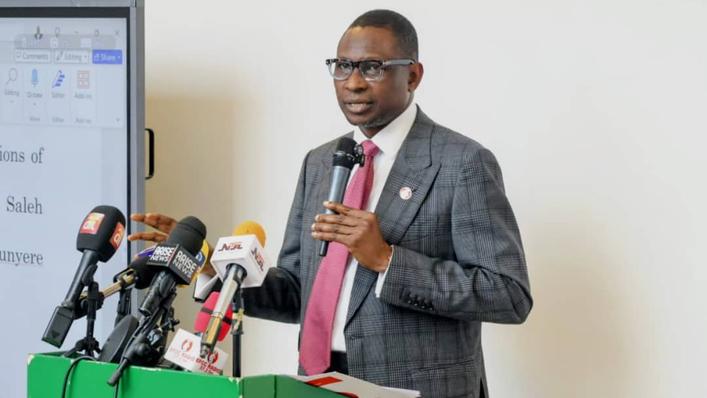
Olukoyede disclosed this on Monday at a media briefing at the EFCC headquarters in Abuja, where he reviewed his 34-month stewardship of the Commission.
According to him, between October 2023 and July 2026, the EFCC received 49,673 petitions, investigated 39,615 cases and filed 14,476 charges in court, resulting in 10,872 convictions.
He said the figures represented a conviction-to-filing ratio of 75.1 per cent, while 1,370 convictions were recorded from 1,889 filings in the first half of 2026 alone.
“These results reflect diligence, resilience, and a prosecutorial approach anchored on evidence and courtroom outcomes,” Olukoyede told journalists.
EFCC recovers N1.23tn, $684m
On asset recovery, the EFCC chairman said the Commission recovered N1.233 trillion between October 1, 2023 and June 30, 2026.
He added that the recoveries included $684.48 million, £373,905.78 and €9.34 million, as well as other foreign currencies.
Olukoyede said about N397.26 billion, representing 33 per cent of the naira recoveries, went directly to the Federal Government, while N836.34 billion, or 67 per cent, represented indirect recoveries made on behalf of ministries, departments and agencies, state revenue services, private companies, individuals and foreign victims.
“Two out of every three naira recovered were on behalf of beneficiaries other than the Federal Government,” he said.
The EFCC chairman also disclosed that N661.32 billion and $492.37 million were disbursed to beneficiaries during the period under review.
He said about N325.35 billion was paid directly to individuals and corporate bodies, while N335.97 billion was remitted to MDAs and state revenue services.
Olukoyede said the Commission had continued to prosecute high-profile cases irrespective of the status of suspects.
He said the EFCC’s case portfolio included former governors, ministers, heads of government agencies, financial-sector executives and corporate officials.
He cited the convictions of Saleh Mamman, Robert Orya and Chukwunyere Nwabuoku as examples of the Commission’s resolve.
“No office or title places anyone beyond the reach of the law,” he said, stressing that the EFCC would investigate professionally, prosecute cases based on evidence and allow the courts to determine guilt or innocence.
On its specialised enforcement activities covering money laundering, unlicensed bureaux de change, illegal mining, virtual assets and terrorist financing, the EFCC recorded 920 cases and secured 212 convictions.
Money laundering and unlicensed BDC operations accounted for the largest share of the cases.
Olukoyede said 234 BDC-related cases were investigated, resulting in 73 convictions, adding that the enforcement complemented Central Bank of Nigeria reforms aimed at stabilising the foreign exchange market.
Beyond cash recoveries, the Commission secured forfeiture orders covering 10,053 tangible assets.
These included 8,198 electronic devices, 1,177 real estate properties, 370 vehicles and 251 plots of land, alongside schools, factories, hotels, oil rigs, barges and aircraft.
The EFCC also secured the forfeiture of 102 tonnes of solid minerals, while proceeds from disposed assets generated about N12.07 billion for the Federal Government.
Olukoyede linked the Commission’s enforcement activities to Nigeria’s exit from the Financial Action Task Force (FATF) Grey List in October 2025, describing the development as a national milestone to which EFCC casework contributed significantly.
He highlighted the use of recovered proceeds for public purposes, including N50 billion allocations made in August 2024 and again in 2026 to the Nigerian Education Loan Fund and Nigerian Consumer Credit Corporation.
He also cited the conversion of a forfeited property into the Federal University of Applied Sciences, Kachia, Kaduna State, which admitted 1,909 students in December 2025.
According to him, another private university has also been forfeited to the Federal Government.
He also said more than 40 of its personnel were dismissed for alleged corruption and financial malpractice in the past three years, while at least five others are facing prosecution.
Olukoyede said the disciplinary actions were part of efforts to ensure that officers of the anti-graft agency were subjected to the same accountability standards it demands of members of the public.
He said, “In the past two and a half to three years of my service, I have asked them to dismiss over 40 staff on account of corruption and financial malpractice. More than five of them are being prosecuted at the moment.”
According to him, while some of the affected officers have already been taken to court, case files involving others are being prepared for prosecution.
The EFCC chairman said the commission could not afford to treat corruption within its ranks differently from similar offences committed by people investigated by the agency.
“You can follow those cases in court; they are public knowledge. If that is what people do in other agencies and I arrest them, I investigate them, I prosecute them, why must I just dismiss you if you do it within our own system and I’m not prosecuting you?” he asked.
Olukoyede stressed that EFCC personnel must maintain high ethical standards if the commission is to retain credibility in its fight against financial crimes.
READ ALSO:TMSG tackles Atiku over ‘Thieves’ remark, questions his record
“You must be sure that your hands are clean. You can’t be fighting corruption when your hands are soiled with corrupt practices,” he said.
As part of what he described as an internal cleansing exercise, the chairman announced the renaming of the commission’s former Internal Affairs Department as the Department of Ethics and Integrity.
He said the restructuring was designed to strengthen internal oversight and promote ethical conduct among personnel.
The commission has also introduced a new gift policy aimed at preventing conflicts of interest and improving transparency among its officers.
Olukoyede explained that personnel would be required to declare gifts above a prescribed value, including gifts received from friends and relatives within and outside Nigeria.
The policy, he added, would specify the categories of gifts officers could accept and require them to account for their sources of income and standard of living.
On institutional reforms, Olukoyede said the Commission had introduced updated guidelines on arrest and bail and established the Department of Fraud Risk Assessment and Control, a dedicated Security Department, Immigration and Visa Section and Cybercrime Rapid Response Centre.
He said new directorates had been commissioned in Enugu, Ilorin, Ekiti, Anambra and Katsina states, while nearly 60 per cent of the Commission’s internal processes had been digitalised.
The EFCC chairman also highlighted collaboration with domestic security agencies and international partners, including the FBI, UK National Crime Agency, Royal Canadian Mounted Police and INTERPOL.
He added that he had been re-elected President of the Network of National Anti-Corruption Institutions in West Africa (NACIWA) for another three-year term.
Looking ahead, Olukoyede said the EFCC would focus on strengthening preventive measures, accelerating restitution, investing in advanced investigative technology and improving professional standards in its engagement with citizens.
He expressed appreciation to President Bola Tinubu, the National Assembly, judiciary, civil society organisations, media and Nigerians for their support.
“We will never take your trust and confidence for granted,” he said.