By Seun Ibiyemi
The Minister of Marine and Blue Economy, Dr. Adegboyega Oyetola, has urged the judiciary to prepare for a new generation of maritime disputes arising from autonomous vessels, digital shipping systems and the global transition to cleaner maritime transport.
Oyetola made the call on Wednesday while delivering the keynote address at the opening of the 18th International Maritime Seminar for Judges, organised by the Nigerian Shippers’ Council (NSC) in collaboration with the National Judicial Institute (NJI) in Abuja.
The minister said the rapid advancement of maritime technology was creating unprecedented legal challenges relating to liability, navigational responsibility, insurance, collision regulations and accountability when autonomous ships or their systems fail.
“The prospect of vessels operating with limited or no human crews raises fundamental questions concerning liability, navigational responsibility, insurance, collision regulations, and the allocation of legal responsibility when technology fails,” Oyetola said.
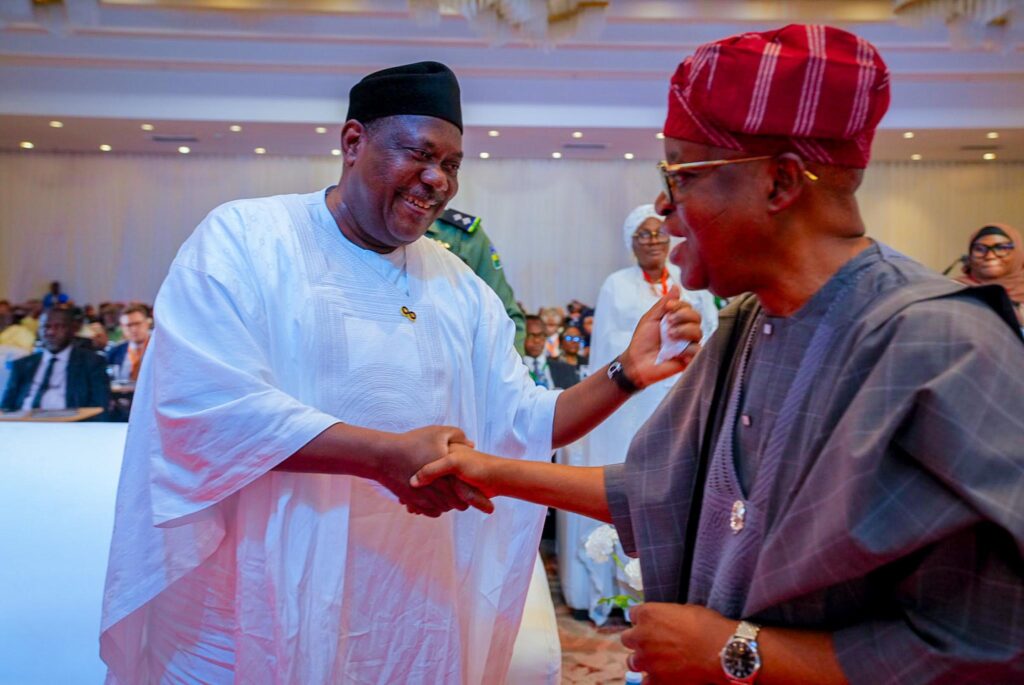
L-R: Secretary to the Government of the Federation, Senator George Akume (left) and the Minister of Marine and Blue Economy, Dr. Adegboyega Oyetola, at the 18th International Maritime Seminar for Judges organised by the Nigerian Shippers’ Council and the National Judicial Institute in Abuja, on Wednesday.
He noted that the increasing digitalisation of global shipping through electronic bills of lading, blockchain-enabled cargo documentation and digital freight contracts was transforming international commerce while introducing fresh evidentiary, contractual and jurisdictional concerns.
According to him, the global push toward maritime decarbonisation and environmental sustainability would also generate complex disputes over pollution liability, regulatory compliance and the enforcement of evolving international standards.
Oyetola urged judges to approach such cases with sound legal reasoning, scientific understanding and knowledge of emerging international jurisprudence.
He stressed that strengthening mechanisms for the prompt resolution of shipping disputes through litigation and arbitration would position Nigeria as Africa’s leading maritime hub.
“Every judgment delivered in a maritime matter sends a powerful message — not only to the litigants before the court, but also to international investors, shipowners, financiers, insurers, cargo interests and seafarers across the world,” the minister said.
“A predictable, well-reasoned and internationally informed judiciary is itself an instrument of economic competitiveness.
It lowers transaction costs, enhances commercial confidence, encourages parties to choose Nigerian courts and Nigerian arbitration centres for the resolution of maritime disputes, and reinforces Nigeria’s reputation as a credible destination for maritime investment.”
The minister disclosed that the Federal Government would support the expansion of specialised maritime divisions within the Federal High Court, align domestic legislation with contemporary international maritime conventions and promote alternative dispute-resolution mechanisms, particularly maritime arbitration.
Describing judicial excellence as a strategic economic asset, Oyetola said investments in judicial capacity would strengthen Nigeria’s competitiveness in the global maritime economy.
He also highlighted major achievements in the maritime sector, including the Federal Government’s £746 million financing agreement with the United Kingdom for the modernisation of Apapa and Tin Can Island ports.
According to him, the planned disbursement of the Cabotage Vessel Financing Fund would enable indigenous shipowners to acquire vessels, increase participation in coastal shipping and create about 30,000 jobs.
The minister further noted that Nigeria had maintained four consecutive years without piracy incidents in its territorial waters through the Deep Blue Project, while maritime agencies generated more than ₦1.8 trillion in revenue in 2025.

L-R: Chairman of the Governing Board of Nigerian Shippers’ Council (NSC), Dr. Ibrahim Shehu Shema; Permanent Secretary, Federal Ministry of Marine and Blue Economy, Mrs. Fatima Mahmood; Minister of Marine and Blue Economy, Dr. Adegboyega Oyetola; Secretary to the Government of the Federation, Senator George Akume, and the Chief Justice of Nigeria, Justice Kudirat Kekere-Ekun, at the 18th International Maritime Seminar for Judges organised by the Nigerian Shippers’ Council and the National Judicial Institute in Abuja, on Wednesday.
He added that domestic fish production had increased from about 1.1 million metric tonnes to 1.4 million metric tonnes.
Oyetola said the expansion of offshore renewable energy, aquaculture, seabed resources and coastal tourism would inevitably lead to more disputes involving investors, regulators and host communities.
READ ALSO:Oyetola celebrates SWDC MD, Charles Akinola at 70
“The marine and blue economy cannot flourish in a legal vacuum,” he said, stressing the need for courts with the expertise and courage to interpret increasingly sophisticated international maritime laws.
Also speaking, the Secretary to the Government of the Federation, Senator George Akume, underscored the importance of speedy admiralty justice, warning that delays in resolving maritime disputes could undermine trade, shipping operations, investment and economic growth.
Akume also urged government agencies to improve collaboration, noting that the complexity of the maritime and blue economy sectors requires stronger institutional coordination.
The Chief Justice of Nigeria, Justice Kudirat Kekere-Ekun, who declared the seminar open, described the maritime industry as a critical driver of international trade, employment and national revenue.
She stressed that maritime disputes often involve complex and time-sensitive cross-border transactions, adding that delays in adjudication could disrupt commercial activities, increase costs and weaken investor confidence.
Justice Kekere-Ekun also highlighted the need for greater cooperation among courts, judicial officers, regulators and legal practitioners, given the international nature of maritime commerce.
Similarly, Speaker of the House of Representatives, Tajudeen Abbas, represented by the Deputy Chief Whip, Ibrahim Ayokunle Isiaka, reaffirmed the National Assembly’s commitment to enacting laws and carrying out oversight functions to support the growth of the maritime sector.
The seminar, which runs from July 22 to July 24, has attracted chief justices from The Gambia, Ghana, Kenya, Liberia and Sierra Leone, alongside justices of the Supreme Court and Court of Appeal, judges, legal scholars, arbitrators and maritime law practitioners.