By Seun Ibiyemi
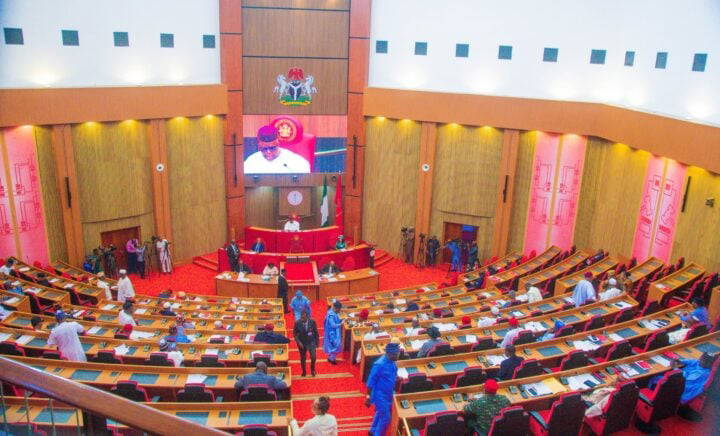
The Senate on Wednesday approved the 2026 budget proposal of the Nigerian Customs Service (NCS), endorsing a revenue target of ₦11.074 trillion and an expenditure estimate of ₦1.295 trillion for the 2026 fiscal year.
The approval followed the adoption of the report of the Senate Committee on Customs, Excise and Tariffs during plenary after lawmakers considered the agency’s 2025 budget performance and projections for 2026.
Presenting the report, Chairman of the Committee, Senator Isah Jibrin, said the Customs Service surpassed its 2025 revenue target of ₦6.5 trillion, generating approximately ₦7.2 trillion, representing 110.53 per cent performance.
He, however, noted that the agency could have generated more revenue but for the suspension of excise duty on telecommunications services, fiscal policies encouraging local production of healthcare products, and disruptions to global trade caused by the Russia-Ukraine conflict, which affected imports, particularly wheat.
On expenditure, Jibrin disclosed that although the Customs Service had an approved budget of about ₦1.132 trillion in 2025, actual spending stood at ₦591 billion.
He attributed the low capital budget implementation to delays in project approvals by the Bureau of Public Procurement (BPP) and the Federal Executive Council (FEC), resulting in several capital projects being rolled over to the 2026 fiscal year.
According to the committee, the Customs Service plans to achieve its ambitious revenue target through expanded deployment of technology, strengthened revenue recovery mechanisms, real-time audit systems, improved trade facilitation and intensified anti-smuggling operations.
The proposed expenditure of ₦1.295 trillion comprises ₦421 billion for personnel costs, ₦307 billion for overheads and ₦565 billion for capital projects.
The committee noted that the budget would be financed mainly through the statutory four per cent Free on Board (FOB) levy provided under the Nigerian Customs Service Act, 2023.
Based on its findings, the committee recommended Senate approval of both the proposed revenue target and expenditure estimates.
Contributing to the debate, Deputy Senate President Barau Jibrin commended the committee for what he described as a comprehensive report and praised the Comptroller-General of Customs, Bashir Adeniyi, and officers of the Service for exceeding their revenue target.
He said the impressive performance justified President Bola Tinubu’s decision to extend the tenure of the Comptroller-General.
“You have an entity that budgeted to generate about ₦6.5 trillion but ended up generating ₦7.2 trillion. That is a wonderful performance, and we cannot commend the Comptroller-General and his team enough,” Barau said.
He also noted that despite the substantial increase in revenue generation, the agency spent only ₦591 billion in 2025, with a significant proportion of the expenditure directed towards capital projects rather than recurrent costs.
According to him, the proposal to generate over ₦11 trillion in 2026 demonstrates the confidence of the Customs leadership in the ongoing reforms and innovations within the Service.
“For an agency to propose generating ₦11 trillion and spending only ₦1.2 trillion to run its operations shows remarkable fiscal discipline. This is an institution Nigerians should be proud of,” he added.
READ ALSO:Customs, NRS, PEBEC review National Single Window performance in Apapa
Senate President Godswill Akpabio subsequently put the committee’s recommendations to a voice vote, with lawmakers unanimously approving both the revenue target and expenditure estimates.
Akpabio commended the Senate Committee on Customs, Excise and Tariffs for its detailed scrutiny of the proposal and congratulated the leadership of the Nigerian Customs Service on its strong revenue performance.
He expressed confidence that the approved budget would strengthen the operations of the Service, enhance trade facilitation and boost non-oil revenue generation for the Federal Government.
The approval comes as the National Assembly continues consideration of the 2026 budgets of key revenue-generating agencies, with the Federal Government relying on improved non-oil revenue mobilisation to support budget implementation and reduce dependence on borrowing.