

By Seun Ibiyemi
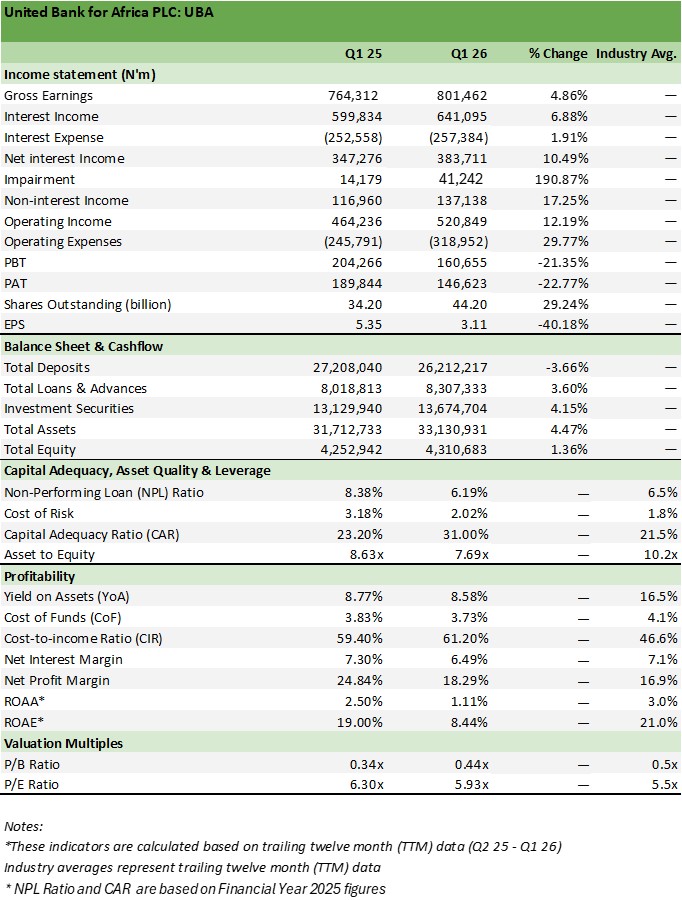
United Bank for Africa Plc (UBA) has reported a mixed financial performance for the first quarter of 2026, as solid revenue growth was offset by surging credit losses and higher operating expenses.
The results highlight continued pressure on profitability following challenges in the 2025 financial year, with impairment charges rising sharply as the bank intensifies efforts to clean up its loan portfolio after the end of regulatory loan forbearance by the Central Bank of Nigeria.
Under the new regulatory environment, banks are required to fully recognise non-performing loans, bringing greater transparency but also exposing weaknesses in credit quality.
This shift significantly impacted UBA’s earnings in the period under review.
Despite these headwinds, the bank recorded growth in key income lines. Gross earnings rose by 4.9 per cent year-on-year to ₦801.5 billion, driven by a 6.9 per cent increase in interest income and a 17.3 per cent rise in non-interest revenue to ₦137.1 billion.
The performance was supported by improved lending activity and stronger fee-based income.
Net interest income also grew by 10.5% to ₦383.7 billion, aided by relatively controlled funding costs.
However, net interest margin declined to 6.5 per cent, reflecting some pressure on asset yields.
On the downside, impairment charges surged by 190.9 per cent to ₦41.2 billion, reflecting increased credit risk provisioning.
Although the bank’s cost of risk improved to 2.0 per cent, it remained above the industry benchmark of 1.8 per cent, pointing to lingering risk management challenges.
Operating expenses also climbed significantly, rising 29.8 per cent to ₦319 billion.
READ ALSO:AKOD seeks stronger collaboration with LASPA to improve parking management
This pushed the cost-to-income ratio to 61.2 pet cent, as revenue growth was insufficient to offset rising overheads.
Consequently, profit after tax declined by 22.8 per cent to ₦146.6 billion. Earnings per share dropped more sharply by 40.2 per cent, largely due to share dilution following the bank’s 2025 capital raise.
Key performance indicators weakened further, with return on average assets falling to 1.11 per cent and return on average equity declining to 8.44 per cent.
Analysts say UBA now faces a critical balancing act in 2026, as it seeks to restore profitability through tighter credit controls, improved efficiency, and stronger returns on its asset base.
Without a sustained rebound, they warn that valuation recovery may remain limited despite the bank’s strong revenue base and extensive pan-African presence.