By Seun Ibiyemi
The National Agency for Food and Drug Administration and Control (NAFDAC) has announced a 50 per cent reduction in product registration fees for micro, small and medium enterprises (MSMEs) with five or fewer employees, as part of efforts to ease regulatory compliance and support small businesses.
The Director-General of NAFDAC, Prof. Mojisola Adeyeye, disclosed this at the SMEDAN-NAFDAC Summit held in Lagos on Monday, where she assured entrepreneurs that the agency was not established to frustrate small businesses but to protect consumers and guide manufacturers towards producing safe, wholesome and quality products.
Adeyeye acknowledged that many MSME operators associate NAFDAC with high fees, delays and cumbersome documentation, but said the agency was repositioning itself as an enabler of industry while maintaining its regulatory responsibilities.
She described MSMEs as major employers of labour, contributors to Nigeria’s economic growth and important custodians of indigenous food and health products.

L-R: Director General of Bureau of Public Procurement BPP, Dr. Adebowale Adedokun, the Director General, National Agency for Food and Drug Administration and Control, NAFDAC, Prof. Mojisola Adeyeye and Mrs Folasade Bada Ambrose-Medebem, Lagos State Commissioner for Commerce, Cooperative, Trade and Investment at the SMEDAN–NAFDAC Summit in Lagos.
According to her, NAFDAC is committed to making the journey from developing a product to securing registration and accessing local and international markets shorter, affordable and predictable.
She explained that a NAFDAC registration number represents more than a label requirement, describing it as a mark of trust that assures consumers and international buyers that a product has been evaluated and its manufacturer operates within an acceptable quality and safety framework.
The NAFDAC boss explained that the agency’s registration and licensing procedures are designed to ensure that regulated products meet applicable standards of safety, quality and efficacy.
She noted that NAFDAC operates under the National Agency for Food and Drug Administration and Control Act, Cap. N1, Laws of the Federation of Nigeria, 2004, which empowers it to regulate the manufacture, importation, exportation, distribution, advertisement, sale and use of food, drugs, cosmetics, chemicals, detergents, medical devices and packaged water.
Adeyeye added that the agency is ISO 9001:2015-certified and has attained Maturity Level 3 under the World Health Organisation’s Global Benchmarking framework for regulatory authorities, with Level 4 as its next target.
During an interactive session with MSME operators, she outlined four basic stages of product registration: documentation, facility inspection, laboratory analysis and approval.
Applicants are expected to obtain relevant product-category guidelines from NAFDAC’s website and submit applications and supporting documents through the NAFDAC Automated Product Administration and Monitoring System (NAPAMS).

L-R: The Director General, National Agency for Food and Drug Administration and Control, NAFDAC Prof. Mojisola Adeyeye, Registrar and CEO of the Corporate Affairs Commission, CAC, Mallam Hussaini Ishaq Magaji, Hon Minster for Industry, Senator John Owan Enoh, DG SMEDAN, Dr Charles Odii and Director General of Bureau of Public Procurement BPP, Dr. Adebowale Adedokun at the SMEDAN–NAFDAC Summit in Lagos.
After payment of applicable fees, the manufacturing facility is scheduled for inspection to assess compliance with Good Manufacturing Practices or Good Hygienic Practices.
Product samples are subsequently subjected to laboratory analysis to determine whether they meet the required quality and safety standards. Products that satisfy the requirements receive marketing authorisation and a NAFDAC registration number.
Adeyeye said NAFDAC had introduced several measures to reduce the cost, time and procedural difficulties associated with product registration by small businesses.
Apart from the 50 per cent reduction in registration charges for companies with five or fewer employees, the measures include electronic and assisted registration through NAPAMS, a dedicated Small Business Support Desk, expedited laboratory analysis and decentralised registration through the agency’s zonal offices.
She also disclosed that NAFDAC allows the registration of similar low-risk products manufactured in common or shared facilities, while offering free counselling and guidance through its zonal and state offices.
According to her, the electronic registration platform enables MSMEs to submit and track applications from their workplaces or homes, reducing travel expenses, improving transparency and limiting opportunities for sharp practices.
The Director-General, however, cautioned business owners against relying on consultants and agents to facilitate registration, noting that incomplete documentation, inadequate product labelling and manufacturing facilities that are not ready for inspection often cause delays.
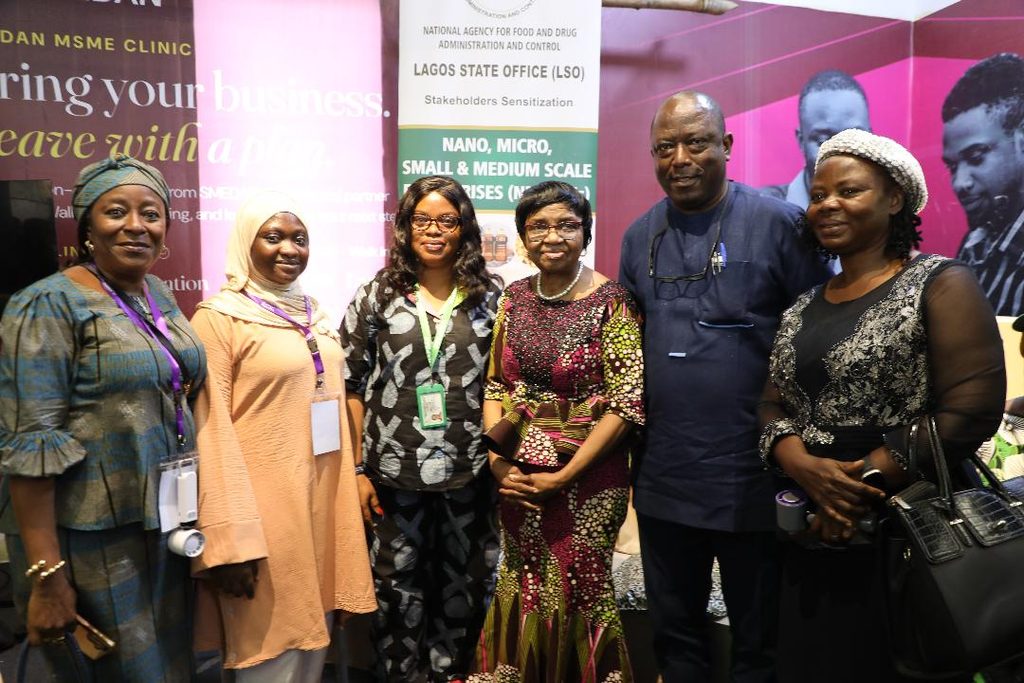
Fourth from right, the Director General, National Agency for Food and Drug Administration and Control, NAFDAC Prof. Mojisola Adeyeye, Deputy Director, NAFDAC ISOTO, Mrs Sarah Ajayi, Deputy Director/Head, NAFDAC Lagos State Office LSO, Dr Tunde Sigbeku and Deputy Director, NAFDAC Laboratory Services, Oshodi, Mrs Oluyemisi Odofin DD lab Services Oshodi at the SMEDAN–NAFDAC Summit in Lagos.
She expressed concern that some entrepreneurs had paid several millions of naira to agents not recognised by NAFDAC for services that could have attracted significantly lower official charges.
Adeyeye urged applicants to engage directly with the agency before submitting applications, stressing that early consultations could save businesses time and money.
She added that registration timelines were shorter when applications were complete, facilities were ready for inspection, applicants responded promptly to compliance directives and product samples met required standards.
On export opportunities, Adeyeye said Nigerian MSMEs had significant potential to expand into international markets through products such as processed foods, spices, cocoa and cashew derivatives, shea products, herbal and traditional preparations, and cosmetics.
She noted that the African Continental Free Trade Area (AfCFTA), which brings together a market of more than one billion people, offered considerable opportunities for Nigerian manufacturers.
However, she warned that products could be rejected in foreign markets if exporters failed to comply with regulatory requirements, citing contamination, poor packaging and the absence of appropriate registration and certification as common reasons for rejected consignments.
She said such rejections cost exporters money, damage Nigeria’s reputation and create additional obstacles for other businesses seeking access to international markets.
“Our shared target must be zero rejection of Nigerian exports,” she said.
To support businesses seeking international market access, Adeyeye highlighted NAFDAC’s export certification services, technical support, laboratory testing and guidance on Good Manufacturing Practices, Good Hygienic Practices and applicable sanitary and phytosanitary requirements.
She explained that, depending on the product and the requirements of the importing country, NAFDAC issues export certificates, health certificates, certificates of pharmaceutical products and certificates of free sale.
The agency also provides registered exporters with technical support and access to free or highly subsidised laboratory testing, including analyses for mycotoxins, pesticide residues and heavy metals.
Adeyeye said these tests were important in determining whether products could meet the requirements of the European Union and other markets with stringent quality and safety standards.
She added that NAFDAC had organised export workshops across the country and was engaging freight consolidators, clearing agents and pre-shipment inspection agents to promote compliance and the use of electronic channels for export certification.
The agency also participates in the AfCFTA National Approval Committee and relevant trade liberalisation arrangements, while collaborating with sister agencies to help exporters meet applicable requirements.
READ ALSO:NNPC advances Methane reporting to level 3 international standard at COP31
The NAFDAC Director-General expressed concern that some exporters still bypass regulatory procedures, ship products without required laboratory testing, use labels that do not meet destination-market requirements or delay renewal until their product registrations expire.
She urged business owners to register their products early, maintain valid registration and apply for renewal before expiration.

L-R: The Director General, National Agency for Food and Drug Administration and Control, NAFDAC Prof. Mojisola Adeyeye and Director General, Women Development Centre, Dr. Adedayo Benjanims-Laniyi at the SMEDAN–NAFDAC Summit in Lagos.
She also advised manufacturers to build quality into every stage of production, from raw material sourcing to packaging and distribution, rather than relying solely on laboratory testing after production.
Adeyeye encouraged entrepreneurs to engage NAFDAC before designing product labels, constructing manufacturing facilities or planning export consignments, while treating inspections as opportunities to improve their operations.
She further warned against improper payments, insisting that applicants did not need to pay agents or agency insiders to access services available through the official process.
Business owners were also encouraged to report any demand for improper payment to the agency.
Adeyeye said the future of Nigeria’s economy would depend significantly on the ability of MSMEs to grow, formalise their operations and compete in local and international markets.
She reaffirmed NAFDAC’s readiness to guide small businesses through the registration and compliance process, adding that safe and properly registered Nigerian products could progress from local markets to retail shelves around the world.
“Compliance is not the end of the entrepreneurial journey; it is the passport that allows a product made in Nigeria to be trusted at home and respected abroad,” she said.