By Seun Ibiyemi
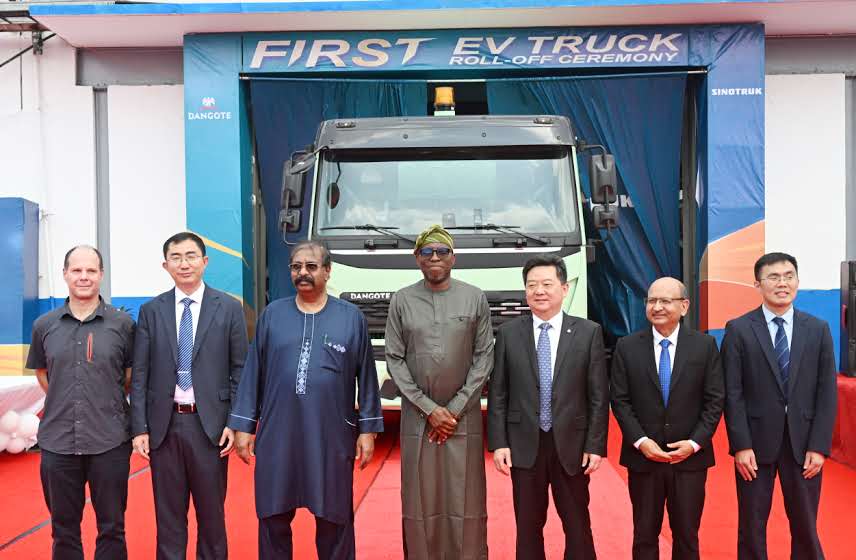
Dangote Sinotruk West Africa Limited has unveiled Nigeria’s first locally assembled electric heavy-duty truck, marking a major development in the country’s automotive manufacturing industry and its transition towards cleaner commercial transportation.
The electric vehicle was rolled out at the company’s assembly facility in Ikeja, Lagos, at an event attended by representatives of the Dangote Group, Sinotruk Group, the Lagos State Government, industry stakeholders, customers and business partners.
The development marks an expansion of the Dangote-Sinotruk joint venture into new-energy mobility, adding electric heavy-duty trucks to its existing range of commercial vehicles, including conventional heavy-duty trucks, tippers, light trucks, pickups and buses.
Speaking at the event, Group Vice-President of Dangote Industries Limited, Devakumar V.G. Edwin, said the introduction of electric commercial vehicles represented another milestone in the partnership and reflected the Group’s commitment to adopting emerging technologies that support business growth and environmental sustainability.
He said the partnership was established to build a world-class commercial vehicle business in Nigeria through local assembly, technology transfer, employment creation and industrial development.
According to Edwin, Dangote Group conducted extensive evaluations of Chinese truck manufacturers before selecting Sinotruk as its technology partner.
He said the company had moved from conventional vehicles into compressed natural gas (CNG) technology and was now expanding into electric mobility in response to changing global automotive trends.
“Today, we are taking an important further step as the global economy is looking for sustainable business, that is, vehicles which will also be protective of the environment. So, we went into CNG technology and now we are going into the electric technology. This is a technology which is revolutionising the whole world,” Edwin said.
The Dangote executive said electric commercial vehicles offered the potential to reduce operating costs and tailpipe emissions, depending on their applications, electricity costs and availability of charging infrastructure.
He noted, however, that successful adoption would require reliable charging facilities, technical expertise, spare parts and effective after-sales support.
Edwin said Dangote Sinotruk was already preparing the necessary technical support systems and assembling a team to assist customers with the deployment and maintenance of the vehicles.
He added that the company would work with government stakeholders, business partners and customers to support the development of Nigeria’s electric vehicle ecosystem, including charging infrastructure.
Describing the rollout as more than a product launch, he said it demonstrated the Group’s commitment to innovation, green energy and the future of mobility.
“This is more than a launch of new vehicles. It’s a statement of our commitment to innovation, our commitment to green energy, and the future of mobility,” he said.
President of Sinotruk Group, Liu Wei, described the rollout as a historic development for Nigeria, the joint venture and Africa’s automotive industry.
He said the electric heavy-duty truck represented a practical contribution to Nigeria’s energy-transition ambitions and a major step towards localised manufacturing of new-energy commercial vehicles in West Africa.
“Today, we gather in the beautiful city of Lagos to witness the official roll-off of the first electric heavy-duty truck from the joint venture. More importantly, it represents a substantial step forward for Nigeria and West Africa in driving localised manufacturing and the green transition of new-energy commercial vehicles,” Liu said.
He noted that the initiative aligned with Nigeria’s long-term carbon-neutrality objectives and energy-transition plans, particularly efforts to modernise the energy mix, reduce transportation emissions and strengthen domestic industrial capacity.
Liu traced the partnership between Sinotruk and Dangote Group to 2010, with the joint venture formally established in 2014.
The partnership recorded another milestone in 2017 when its first heavy truck rolled off the assembly line, while a commercial vehicle welding and e-coating paint line became operational in 2024, further deepening local manufacturing capabilities.
READ ALSO:Lagos denies ₦700m billboard permit fee claim
He disclosed that the joint venture had assembled more than 8,000 vehicles locally and would continue upgrading its production capacity to serve Nigeria and the wider West African market.
Liu also pledged continued investment in training and skills development for Nigerian engineers and technicians, including opportunities for selected personnel to receive practical training at Sinotruk facilities in China.
The Lagos State Government welcomed the development, describing it as a significant milestone for Nigeria’s industrial and transportation sectors.
A representative of the Commissioner for Transportation said the locally assembled electric truck demonstrated Nigeria’s capacity to participate in the global transition towards cleaner transportation rather than depend entirely on imported automotive technology.
The government highlighted the potential of the initiative to reduce emissions, lower long-term operating costs for transport and logistics operators, create jobs and equip Nigerian engineers and technicians with advanced electric vehicle and sustainable manufacturing skills.
It also commended Dangote Sinotruk for combining global automotive technology with local industrial capacity, urging the company to sustain investments in local manufacturing and technical skills development.
Edwin said Dangote Sinotruk’s long-term ambition was to become one of West Africa’s leading automotive assembly and manufacturing companies, leveraging Nigeria’s market size, industrial base and entrepreneurial capacity to serve the wider region.
He said the company would continue to deepen local assembly, facilitate technology transfer, develop Nigerian technical talent, increase local value addition and create employment opportunities.
The electric truck rollout represents another phase in the company’s expansion, positioning it at the intersection of commercial transportation, automotive manufacturing and Nigeria’s emerging green-energy economy.
For Dangote Group, the development also reinforces its industrialisation strategy of building domestic manufacturing capacity and developing businesses capable of serving markets beyond Nigeria.
The company is seeking to position Nigeria as a strategic automotive manufacturing hub for West Africa, with locally assembled commercial vehicles serving the region’s growing logistics, construction, infrastructure and transportation needs.