…Targets $44bn annual maritime revenue
By Seun Ibiyemi
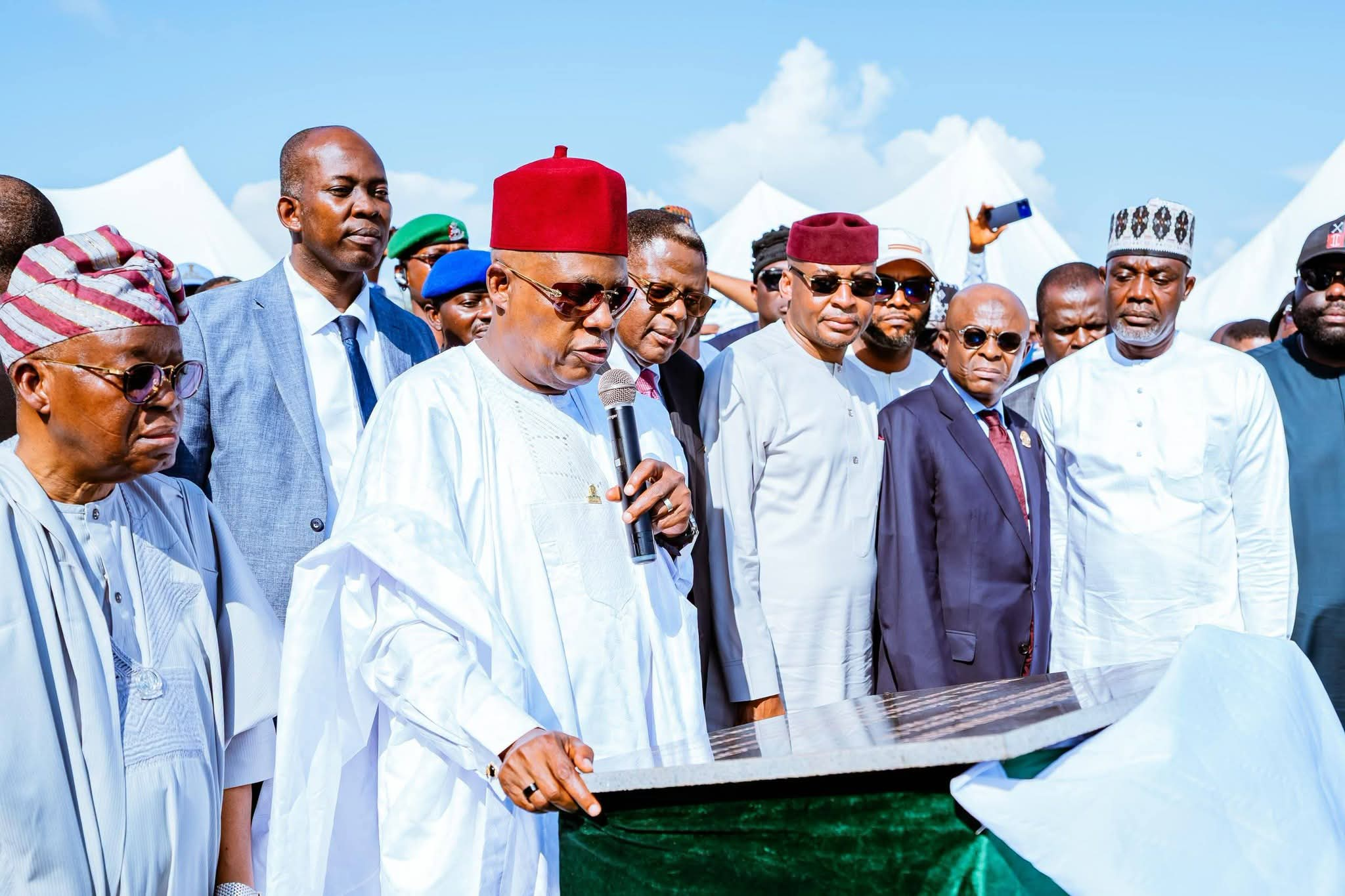
President Bola Ahmed Tinubu has performed the groundbreaking ceremony for the $3.5 billion Bakassi Deep Seaport in Cross River State, describing the project as a major economic investment that could position Nigeria as a leading maritime and blue economy hub.
The presidential flag-off, held on Friday in Bakassi and represented by Vice President Kashim Shettima, marks a significant step towards reviving the long-awaited seaport project, which has faced decades of delays and political, administrative, legal and environmental challenges.
Speaking at the ceremony, Tinubu said he was not in Cross River State merely to attend a ceremonial event but to break what he described as a long-standing jinx surrounding the development of the port.
“I am not in Calabar to cut a ribbon and dance Ekpe masquerade. I am here to break ground and break centuries-old jinx,” he said.
The President recalled that many people had considered the project unattainable, expressing optimism that its commencement would turn a long-standing ambition into reality.
“Many people believed this port would never happen. They said it would be a pipe dream. They said Bakassi would only be remembered for what we lost. Today, we answer them with a shovel, with concrete, with steel, and with hope, a renewed hope that a dream deferred can become a dream actualised,” he added.
The President also dismissed claims that federal authorities or regional interests had deliberately frustrated the development of seaports outside Lagos.
He said his administration was committed to building a decentralised maritime economy in which different parts of the country could contribute to national trade and economic growth.
“There is a rumour I hear in some corners. That the West, Lagos, or Abuja never wanted a port to work anywhere outside Lagos. If that were true, would I be standing here today with a shovel in my hand? Lagos is not our enemy,” he said.
Tinubu described Lagos as a major commercial partner rather than a competitor, arguing that concentrating more than 80 per cent of Nigeria’s foreign trade through one commercial gateway creates congestion and increases the cost of doing business.
He said the concentration of cargo traffic in Lagos could result in ship delays, higher logistics costs and rising prices in markets across the country.
“Lagos is our elder brother in trade. No country eats with one hand. No country carries all its load on one shoulder. That shoulder will break,” he said.
“This project is not against Lagos. It is for Nigeria. When Lagos is free, Nigeria breathes. When Calabar works, Nigeria walks on two legs.”
Tinubu explained that the Bakassi Deep Seaport was conceived during the colonial era and re-engineered in 2014, with its Environmental and Social Impact Assessment completed by March 2015.
The project is designed as a 20-metre-draft deep seaport capable of accommodating large vessels that currently bypass Nigerian waters.
It is also expected to be supported by a 260-kilometre superhighway that will serve as an evacuation corridor, connecting the port to markets across the North, East and West of the country.
The President said the project gained fresh momentum under Cross River State Governor Bassey Otu, following the securing of $3.5 billion in financing from the African Export-Import Bank (Afreximbank).
He added that the state formalised a public-private partnership arrangement in February 2025, while the Federal Government had now fully endorsed the project.
“Today, the Federal Government is standing fully behind it. This is beyond a Cross River dream. It is a Nigerian project. It is a feather in my shackle-breaking cap. It is a poverty breaker. It is history rewritten with love and commitment,” he said.
Tinubu described the blue economy as a major source of untapped national wealth, estimating that Nigeria could generate $44 billion annually from maritime activities if it successfully attracts regional cargo traffic currently handled by neighbouring countries.
He urged residents of Bakassi to support the project and protect it from political interference, describing the seaport as an opportunity to transform the economic fortunes of the area following the loss of the peninsula through the International Court of Justice ruling.
“The same water that took something from you will now bring something back. The Atlantic that people feared will now feed your children. Please stand with this project, protect it from politics and rumour and own it in your soul and by faith,” he said.
The President also appealed for political support for his administration, urging the people to vote for continuity and the Renewed Hope Agenda.
Earlier, Cross River State Governor Bassey Otu said the groundbreaking had fulfilled a long-standing aspiration of the people of Bakassi and revived their hopes for economic transformation.
He urged investors in the maritime sector and related industries to take advantage of the opportunities presented by the project.
READ ALSO:NLNG retains UNEP Gold standard for methane emissions reporting for second year
Otu said the seaport initiative had encountered political, administrative, legal and environmental obstacles under previous administrations, making its actualisation uncertain until Tinubu assumed office.
He expressed appreciation to the President for supporting the state through the approval process, culminating in the issuance of a Certificate of Compliance and final Federal Government approval.
The Minister of Marine and Blue Economy, Dr Adegboyega Oyetola, described the project as a new chapter in Nigeria’s maritime development, economic diversification and regional competitiveness.
He said the Tinubu administration’s Renewed Hope Agenda recognised the importance of productive investment, modern infrastructure, private-sector participation and the effective utilisation of the country’s economic resources in achieving sustainable prosperity.
Similarly, the Managing Director of the Nigerian Ports Authority (NPA), Dr Abubakar Dantsoho, said the seaport would strengthen trade relations between Nigeria and landlocked countries, including Chad, Niger, Mali and Burkina Faso.
He noted that Africa accounts for 16 of the world’s 44 landlocked countries, with four located in West Africa, highlighting the potential market for cargo movement through the proposed port.
The President and Chairman of the Board of Directors of Afreximbank, Dr George Elombi, represented by the bank’s Executive Vice-President, Intra-African Trade and Export Development, Mrs Kanayo Awani, described the $3.5 billion project as significant for Nigeria, Africa and the African Continental Free Trade Area.
She said the port could strengthen Nigeria’s maritime corridor, expand port capacity and facilitate trade with neighbouring economies in West and Central Africa.
Meanwhile, Vice President Kashim Shettima has called on state governments to identify and develop their competitive advantages to accelerate economic transformation.
Speaking at the sixth edition of the African Sub-Sovereign Governments Network (AfSNET) Investment Conference 2026 in Calabar, Shettima said regional prosperity depended on the ability of subnational governments to convert untapped resources into bankable investment opportunities.
The conference was held under the theme, “The Role of Sub-Sovereigns in Catalysing Development through Trade and Investment.”
Shettima said economic development was ultimately experienced at the local level, where roads connect producers to markets, electricity powers industries, agricultural resources are processed, businesses create jobs and communities benefit from economic growth.
“National policies and continental frameworks provide direction, but their success depends significantly on what happens at the sub-national level,” he said.
The Vice President maintained that states and regions should be viewed not merely as administrative units but as economic actors, investment destinations, production centres and gateways to regional and continental markets.
He urged state governments to strengthen their capacity to identify competitive advantages, develop investment-ready projects, attract private capital and establish partnerships capable of delivering sustainable economic outcomes.