
…Seeks increased investment in catfish farming
By Seun Ibiyemi
The Minister of Marine and Blue Economy, Dr Adegboyega Oyetola, has reaffirmed the Federal Government’s commitment to supporting catfish farmers and aquaculture operators to bridge Nigeria’s annual fish supply gap of 2.2 million metric tonnes.
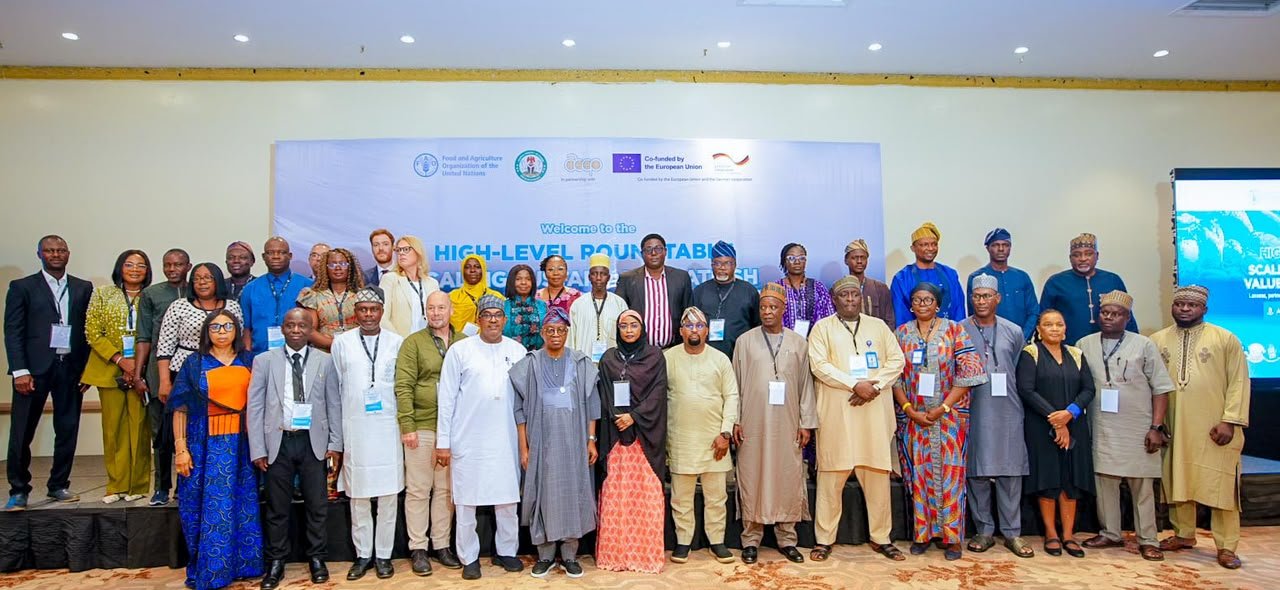
Oyetola made the commitment at the High-Level Roundtable on Scaling Sustainable Catfish Value Chain Transformation, organised under the FISH4ACP programme in Abuja.
The Minister said Nigeria’s annual fish requirement was estimated at 3.6 million metric tonnes, while domestic production stood at approximately 1.4 million metric tonnes, leaving a significant deficit that could be addressed through increased local production.
He said expanding domestic fish production would reduce dependence on imports, create employment opportunities and strengthen national food security.
According to Oyetola, the Federal Ministry of Marine and Blue Economy would continue to collaborate with state governments, financial institutions, development partners and private-sector operators to address challenges facing catfish farmers and create an enabling environment for sustainable growth.
He identified access to affordable financing, quality fingerlings, reasonably priced fish feed, modern hatcheries, effective fish health management, processing facilities, cold-chain infrastructure and reliable markets as priority areas requiring intervention.
READ ALSO:NITDA, NBS launch Nigeria tech outlook report to strengthen digital economy
The Minister particularly urged financial institutions to develop financing arrangements that reflect the production cycles and cash-flow realities of aquaculture businesses to enable viable enterprises to access credit for expansion.
Oyetola noted that Nigeria was already Africa’s second-largest aquaculture producer and a leading producer of farmed African catfish.
He said the country could translate this position into higher production, increased economic opportunities and improved livelihoods through strategic investments and coordinated support across the aquaculture value chain.
The Minister also acknowledged the contributions of the Food and Agriculture Organisation (FAO), the European Union and the German Government through the FISH4ACP programme.
He said the initiative had supported improved farming practices, hatchery management, broodstock development, alternative feed ingredients and digital farm management.
Oyetola reaffirmed the ministry’s commitment to ensuring that catfish farmers, particularly young people, women and small and medium-scale operators, receive the institutional, technical and financial support needed to expand their businesses and contribute to Nigeria’s food security.